If you found this file in an archive use the keyword " nutteingdq " in a
search-engine to find an updated version or related files, or if too recent
then keyword " nutteingd" .
File updated Sep, 2011
Sections
Intro
Technical Terms
Data Protection Act - Subject Access - Forensic Science Service
Cases Highlighting Problems with DNA Profiling
False Matches
Latest estimate of the number of unrelated DNA profile matches
within the NDNAD
A New Variant of Miscarriages of Justice
2001 Criminal Justice and Police Act section
82
The Wider Implications of DNA Profiles - the Attribution Problem
Vulnerability of the UK NDNAD
Technical Problems with DNA Profiles
Lies, Damn Lies and Statistics
Ethnic Normalisation of DNA Profiles
Co-ancestry and Allele Frequency
Losers of the police/forensic DNA lottery
Ethnic Normalisation of DNA Profiles
The D2S1338 Anomaly in the UK
International Normalisation Data Relating to AmpFISTR SGM Plus DNA Profiles
Disturbing Developements for the Orwellian/Kafkaesque Future
Death knell for DNA profiles?
They hound your family, even after death, and through your children
A New Racism ?
Un-investigated Spontaneous Mutations
John Doe Indictments
Future Developements
Exposing Low Copy Number - LCN
Aristotle: The Nicomachean Ethics
We must not expect more precision than the subject-matter admits
...
for it is the mark of an educated man to look for precision in each
class of things just so far as the nature of the subject admits; it is
evidently equally foolish to accept probable reasoning from a mathematician
and to demand from a rhetorician scientific proofs.
Scientific results can never be quoted to greater accuracy than the
worst case scaled contribution of the most error-prone piece of input data.
Twenty three centuries later, great reliance has been placed on the vallidity of
DNA
profiling as a foolproof method of establishing guilt or innocence of a
defendent. In many instances, DNA profiles have been responsible for the
conviction of suspects when no other substantial evidence of their guilt has been
found. In some cases, profiles have been presented as establishing guilt
beyond any reasonable doubt despite other evidence which points to the
accused innocence.
If, as is claimed, the chance of two people sharing the same DNA profile
is greater than one in 100,000,000,000, a positive match between a suspect's
profile and a profile obtained at the scene of a crime would, indeed,
appear to be damning evidence. As that is more than this planets population
over all time, it would be difficult to argue against the two profiles,
having come from the same source, although how the DNA came to be at the
scene of the crime would still have to be established.
The Promega company, that manufactures the kit for doing DNA profile
analysis, trumpets this on their web-page:
ABI SGM Plus ( the system used in the UK ) - Chance for a random match- more than 1 in 100 Billion i.e. 100,000,000,000 or 20 times the population of the earth.
This statement is criminal in its falsity.
About 2/3 way down this file http://www.promega.com/geneticidproc/eusymp2proc/11.pdf
You know the phrase? - if something is too good to be true - then it
probably isn't.
As attested by the number of people 'caught' because their DNA
profile just happens to match a scene-of-crime sample profile.
The figure for potential false matches is now about 1 in 2000 of the
whole UK population. There are many pairs of people around, with
different DNA, but matching DNA profiles.
DNA is unique (twins excepted) but DNA profiles are not unique.
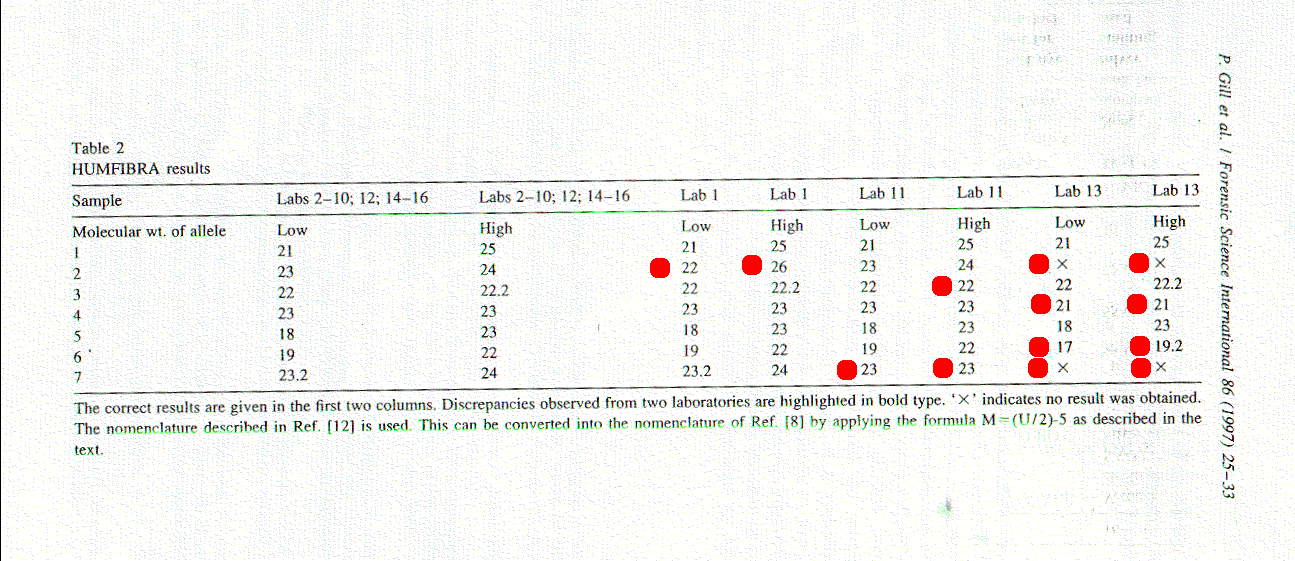
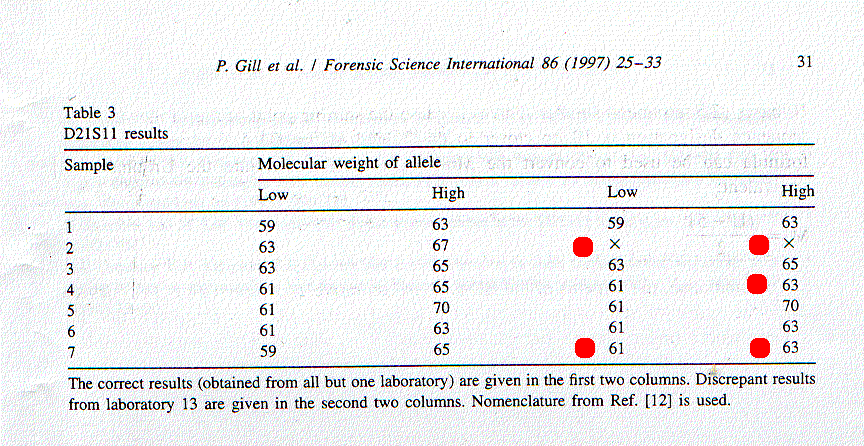
More insurmountable problems, concern the lack of validation of the process. The last proper
International validation exercise in 1997 showed an enormous number of errors.
Then the number of "unresolved matches" in DNA databases that forensic science will
not address.
And finally, inter-relatedness/co-ancestry, if factored into the
analyses,
brings the "match probability" figures down dramatically.
Despite official government sites linking to these files there are
still corrupt persons knocking out my sites, so for the
purposes of searchengines cross-linking them, files no longer
available on the original web hosting sites were on http://www.nutteing.freeukisp.co.uk,
http://www.nutteing.50megs.com/dnapr.htm , http://www.nutteing.freeisp.co.uk/dnapr.htm ,
http://nutteing.no-frills.net/dnapr.htm and http://nutteing3.no-frills.net/dnapr.htm and http://www.nutteing.dabsol.co.uk/dnapr.htm (last 3 due now to host failure )
http://www.nutteing.batcave.net/dnapr.htm , http://home.graffiti.net/nutteing/dnapr.htm
Technical Terms
The technical bit.
I will keep it to a minimum ,but of necessity, some technical words appear in
this article. The following is a brief explanation and glossary.
A locus is a specific area on a chromosome that can be readily identified
and in this article usually concern, unusually,
sequences of DNA ,e.g. ...CGATCGATCGATCGAT...
which is CGAT repeated 4 times. These repeats
are highly variable in number hence their usefulness (VNTR =
Variable Number Tandem Repeat).
The number 4 , in this case, is the allele (variant )
which becomes just one of the 20 numbers
in the (UK) DNA profile.
For each pair of chromosomes there is one
from the mother and one from the father.
So ,4, from one parent and perhaps 6 times
the CGAT repeat from the other parent, so number 6.
So for this one locus a pair of alleles/variants (4,6),
smaller number first by convention, as the origin of each i.e.
mother or father, remains unknown.
Then 9 other loci on different chromosomes giving
10x2 numbers in each profile in the UK NDNAD (National DNA Database) .
The average number of possible alleles, for all races, at each locus is
14. So permutations of selecting from 14 numbers ,
2 at a time, 10 times over is truly a very large number.
But ,a very big BUT, the chance of inheriting a particular
allele is not equal through the range of possible alleles. The number 14
is also reduced if you just consider one ethnicity.
PCR - Polymerase Chain Reaction , the thermocycling amplification process.
STR- Short Tandem Repeat; short, repetitive sequence elements of 2-5 bases. STR's used in DNA profiling are polymorphic, which is to say that the number of repeat elements varies between individuals in a population.
Consider the locus called THO1
Variant Allele (fractional allele) - an STR allele with an incomplete allele. A common THO1 variant allele is 9.3. This allele has 9 full repeats plus 3 nucleotides.
Nucleotide- a building block of DNA or RNA
From a private communication between myself
and Professor Sir Alec Jeffreys to clarify some of this material. "Amelogenin
is used to establish gender. the other markers are not on X or Y; for markers
named DmSnnn (e.g. D2S1338 ), m stands for the number of the chromosome on which the marker is
found. The columns give the marker types found in an individual; e.g. this
person has VWA alleles (variants) type 17 and 19. There's no significance to the
order in which pairs of markers are presented; it's conventional to give the
smaller first. Hence the numbers in the right column are always as big as or
bigger than those in the middle column." Regards Alec Jeffreys
Some
more general information regarding DNA profiles Automsomes occur in pairs, each
individual receives one from their mother and one from the father. Therefore, at
each marker included in SGM+ (the proprietary system used in the UK), a person will receive one from their mother and
one from their father. The child is a composite of the parents. A child will
receive one each of a parents 22 autosome pairs 1 to 22. The child will also
receive one of the mother's X chromosomes (mothers are XX) and either an X
chromosome from the father (female child) or a Y chromosome from the father
(male child)- fathers are XY. There is a 50% chance that any given child will
receive one or the other chromosome pair from each parent.
The following is for
the benefit of people like Fian Dawson who should have a test done with the same
markers assuming a proper "chain of custody". This is to avoid sleight-of-hand,
at the taking of samples, or swapping of samples, and verification of identity, so
the results are forensically admissible. In a standard paternity test that
includes the mother, child and man alleged-to-be the father, the DNA profile of
the child is first compared to that of the mother to identify what the mother
and child have in common using Punnet squares. Then the remaining components in
the child's DNA profile must have come from the biological father. If the man
being tested does not demonstrate those components in his profile then that
would represent exclusionary evidence. If on the other hand, if the tested man
does demonstrate those components in his profile, then that would represent
inclusionary evidence. Therefore, a child is 50% related to both parents, and
50% related to it's siblings, assuming the siblings have the same mother and
father.
Naturally occurring changes in the DNA can create an "apparent" single
exclusion or inconsistency at one marker. They are rare but do occur and should
be taken into account. For example, in comparing the SGM+ profile of a
mother and her child, if at a single marker the mother and child did not share
anything, but did match at the other 9 SGM+ markers, then that single
inconsistency probably resulted from a mutation during oogenesis.
About 1 in 30 DNA profiles will show a disparity between germ-cell
line and buccal cell line for the same individual and one locus. As sperm, as such, would not
be tested for a paternity test then the father could be falsely excluded
in such a circumstance
This file contains many references to files on other internet sources. If the files
have been removed, commonly newspaper sites
firstly- try The Internet Archive ( ww.archive.org)
secondly- try emailing me as I may well have an archived copy
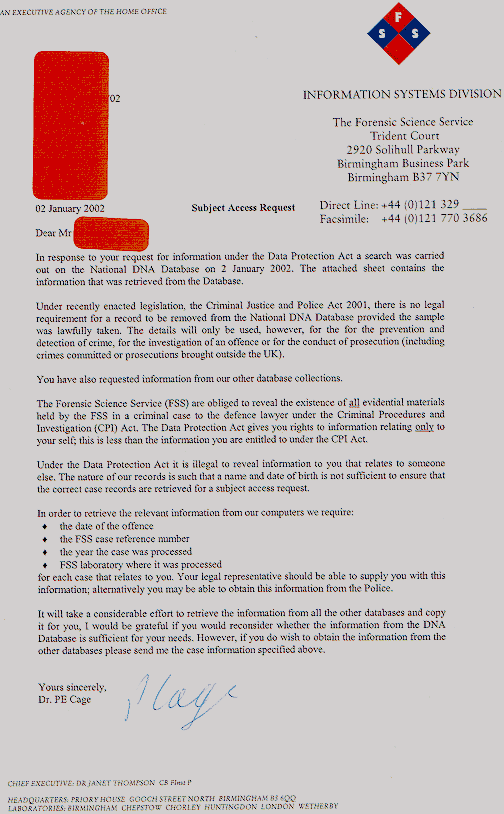
Data Protection Act - Subject Access - Forensic Science Service
Text of the above letter: An Executive Agency
of the Home Office Information Systems Division Forensic Science
Service Trident Court 2920 Solihull Parkway Birmingham Business Park
Birmingham B37 7 YN
Direct Line +44 (0)121 329--- Facsimile +44
(0)121 770 3686 02 January 2002 Subject Access Request In response to your
request for information under the Data Protection Act a search was carried out
on the national DNA Database on 2 January 2002. The attached sheet contains the
information that was retrieved from the Database. Under recently enacted
legislation ,the Criminal Justice and Police Act 2001, there is no legal
reqirement for a record to be removed from the National DNA Database provided
the sample was lawfully taken. The details will only be used, however, for the
for the (sic) prevention and detection of crime, for the investigation of an
offence or for the conduct of prosecution (including crimes committed or
prosecutions brought outside the UK ).
You have also requested information from our other database
collections. The Forensic Science Service (FSS) are obliged to reveal the
existence of all evidential material held by the FSS in a criminal case to the
defence lawyer under the Criminal Procedures and Investigation (CPI) Act. The
Data Protection Act gives you the right to information relating only to
yourself; this is less than the information you are entitled to under the CPI
Act. Under the Data Protection Act it is illegal to reveal information to you
that relates to someone else. The nature of our records is such that a name and
date of birth is not sufficient to ensure that the correct case records are
retrieved for a subject access request. In order to retrieve the relevant
information from our computers we require. the date of the offence the
FSS case reference number the year the case was processed FSS laboratory
where it was processed for each case that relates to you. Your legal
representative should be able to supply you with this information; alternatively
you may be able to obtain this information from the Police. It will take a
considerable effort to retrieve the information from all the databases and copy
it to you, I would be grateful if you would reconsider whether the information
from the DNA Database is sufficient for your needs. However, if you do wish to
obtain the information from the other databases please send me the case
information specified above. Yours sincerely Dr. P E Cage and sig. Chief
Executive: Dr Janet Thompson Headquarters :Priory House Gooch Street North
Birmingham B5 6QQ Laboratories Birmingham Chepstow Chorley Huntingdon London
Wetherby
A valid phone number in Dec 2001 for this lot is 0121
606 2950 So for my entry in
the UK FSS National DNA Database ( NDNAD ).
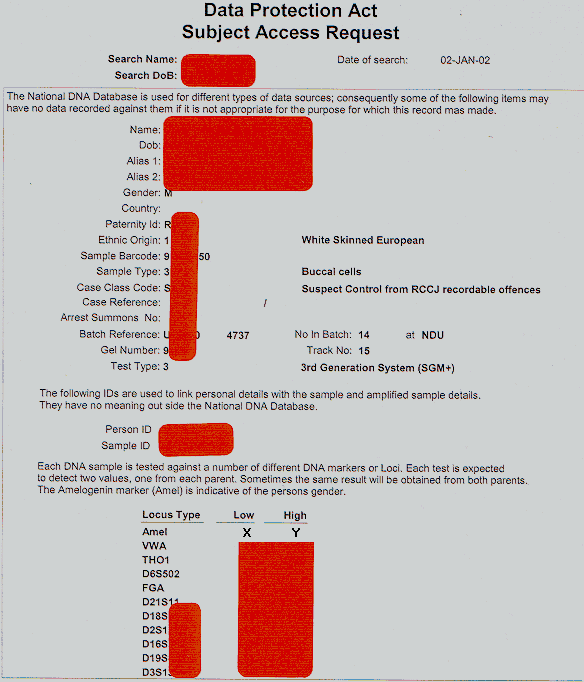
Text of the field designations
and text of this form Data Protection Act Subject Access Request Search
Name ; Search DoB ; Date of search The National DNA Database is used for
different types of data sources; consequently some of the following items may
have no data recorded against them if it is not appropriate for the purpose for
which the record mas(sic) made. Name ; DoB ; Alias 1 ; Alias 2 ; Gender ;
Country ; Paternity Id ; Ethnic Origin: White Skinned European ; Sample Barcode
; Sample Type 3 - Buccal cells ; Case Class Code:SA - Suspect Control from RCCJ
recordable offences ; Case Reference ; Arrest Summons ; Batch Reference ; No in
Batch - at NDU ; Gel Number ; Track No ; Test Type: 3 - 3rd Generation System
(SGM+) The following IDs are used to link personal details with the sample
and amplified sample details. They have no meaning out side(sic) the National
DNA Database. Person ID ; Sample ID Each DNA sample is tested against a
number of different DNA markers or Loci. Each test is expected to detect two
values, one from each parent. Sometimes the same result will be obtained from
both parents. The Amelogenin marker (Amel) is indicative of the persons gender.
Locus Type           Low      High
-------------------------------------
Amel                  X         Y
VWA                   1a        1b
THO1                  2a        2b
D6S502                3a        3b
FGA                   4a        4b
D21S11                5a        5b
D18S51                6a        6b
D2S1338               7a        7b
D16S539               8a        8b
D19S433               9a        9b
D3S1358               10a       10b
End of Form
All the actual numbers (weeded) labelled
b in the right hand column, are greater or equal to, the numerical values in the
middle column marked with "a".
The second line of text on the above covering letter
ending "the record mas made". THIS IS A DYSLEXIC ERROR - letter
reversal/inversion - not a typing error, w and m are nowhere near on a keyboard
(also occurs in dyslexics concerning letters u and n, d and b etc). The other
indicator for dyslexia is this erroneous initial letter is the same as the
initial letter of the next word. Typing letter q, e, a, s or d instead of w is
just sloppy fingers on the keyboard a letter m indicates a sloppy mind. If this
person is involved with the likes of labelling DNA samples or batches then god
help us. "for the for the" shows lack of proof-reading / lack of managerial
supervision.
What do defence attourneys make of such evidence of incompetence when
it arrives on their desks from this country's supposed leading national forensic
laboratory. On 14 January 2002 I received another recorded letter from this lot
in Birmingham. Enclosed was the same 2 sheets as previously; a printout from the
DNA database and a covering letter that the incompetent Dr P E Gage put his signature to. The only
differences (same 2 spelling/proof reading errors) was change of date and
natural variation of signature or very subtle mimiograph of course.
These incompetent idiots don't even know that
what they think is D6S502 on the 6th chromosome
is in fact D8S1179 on the 8th chromosome. Only one of the 10 markers
used in the UK NDNAD - begs the question - What technical competence do
these bods have ?
If this is
representative of the competence of Birmingham Forensic Science Service then all
I can say is be grateful the UK no longer has capital punishment.
The above DNA profile form is appallingly constructed.
To a layman the X and Y at the top of the columns suggest
that the numbers tabulated below the X refer to data from
the X chromosome and under Y from the Y chromosome, which
is erroneous. The reader of such a table, without any previous
knowledge, would assume the figures under the X would relate to the X
chromosome and Y chromosome under the Y with immediate implications
to blood relatives. The amelogenin row should be removed from
the table and placed elsewhere.
http://www.informationcommissioner.gov.uk/cms/DocumentUploads/Report%20Parts%201&2.pdf
http://www.ico.gov.uk/upload/documents/library/corporate/research_and_reports/technology_and_privacy.pdf
Page 33 e. s.
There are 2 citations to some of my internet files
" (Ref) 97
Subject Access Request form to the Forensic Science Service
lodged in 2002 under the Data
Protection Act. An example of this form can be found
at http://www.nutteing.50megs.com/dnapr.htm "
this one is now knocked out because of corrupt persons
lying to the web hosts 50megs.com, no communication
from 'agrieved' direct to me of course. It just means 3
more websites opened up to replace that one knocked out.
The UK Forensic 'Science' Service will not supply this
information as well as a lot more significant stuff.
No one at the Information Commission asked my permission to
link across to my site. I had transcribed as well as
put an image of this information that had cost me 10 GBP.
Honourable people who have contacted me for cross-linking
permission have not only had it granted but also I've advised
them on how to get around the fact that there is no permanence
can be assumed for any of my sites.
I'm not too concerned about cross-linking,
as if I was, I would have made sure everything was not
in simple ASCII text files. The files are there precisely for
public access.
Some history of the UK NDNA database
45,000 profiles in the database in 1991
135,000 in 1995
300,000 in 1998
840,000 in spring 2000
over 1 million in 2001
1,886,000 25 March 2003
5,296,313 01 Sept 2008
[Germany had 36,000 in its BKA DNA database in spring 2000 ]
If the 'Milly Dowler' case was a false match then the figure drops to
about 1 in 200,000 - going down fast now.
"Operation Ruby", reported on http://www.itv.com/news/2093001.html August 08,2003 concerning an implicated parishioner of St Paul's church ,Ryhope,Sunderland. 'Milly Dowler'
From Ireland
http://www.online.ie/news/viewer.adp?article=%203040050
Man freed after DNA evidence deemed not enough
Quote
2003-10-14 :
A Dublin man on trial for murder walked free today when the Central Criminal
Court jury was directed to acquit because DNA evidence alone could not be relied upon.
Mr Justice Butler's direction to the jury to acquit on murder and firearms
charges followed defence submissions that, as there was no corroborative evidence to support the DNA
evidence, the jury should be instructed to acquit the accused Frederick Howe. ...
End Quote
An 'incriminating' DNA profile match is NOT DNA it is :
A set of numbers that may or may not reflect the biology of a miniscule
subset of someone's DNA (error rate in UK terms 0.9 percent)that has been matched, or
substantially partial matched via a computer database
to the same set of numbers derived from a crime-scene
sample stored, more than likely in less than ideal
circumstances, which may or may not reflect
(error rate somewhere between 1 and 7 percent if ideal circumstances) a miniscule
subset of the DNA of someone,
not necessarily the offender, left at
a crime scene maybe decades previously and analysed
degraded and or contaminated , decades later. There is an absolute
best error rate for single kit analysis of
1 in 140 being wrong.
The
Case of Raymond Easton or
Internet archive source
was on http://www.thisiswiltshire.co.uk/wiltshire/archive/2000/08/15/swindon_news10ZM.html
the severely disabled 'cat burglar' from
Swindon,Wiltshire,the case that led to the police having to increase the number
of markers ( loci ) tested from 6 to 10 in the UK DNA profiles
A second case
where unbelievably someone was sentenced to 6 years in prison for having a "DNA
match" after a trawl through the FSS database and the following "corroborative
evidence" "The prosecution relied upon some matters as providing support:
firstly, that the applicant was a smoker or, more accurately, that he had
admitted in interview that he had been on his way to purchase a packet of
cigarettes; secondly, the Crown said it was relevant that the applicant lived in
the general locality of the burglaries (Birmingham); and thirdly, that the appellant was a
man and most safe crackers were male. " Just because some fag butts were
found at the Scene-of-Crime - ask yourself - How many professional burglars hang
around smoking a cigarette while on a job ? The Case of
Robert Watters,Birmingham
Primary source for the Watters appeal court judgement is on Butterworths Lexis Nexis.
From the Court of Appeal judgement concerning Regina v. Watters heard on 19 Oct 2000
Quote
The other evidence results from more stringent tests that have been done on the DNA material that was available in this case. That is partly as a result of a case in which a 6 point match was found to produce two possible suspects, one of whom had been charged despite living at the other end of the country and had to be acquitted when it was appreciated that the DNA matched a second person.
End Quote
A false match in the USA
http://www.suntimes.com/output/news/cst-nws-dna01.html
Quote
DNA links crime to woman with alibi -- she was in jail
November 1, 2004
At first, police thought blood taken from the scene of a North Side
burglary solved the crime because of a DNA match linked to a woman's genetic
profile.
But it turned out the woman had a solid alibi: She was in prison at the time
of the break-in about two years ago, authorities said. ...
"We don't know if the bloodstain is related to the burglary," said Hovey,
who did not know the details of the case. "But DNA is only going to prove
presence. It is not necessarily going to prove someone committed a crime."
Lincoln Hampton, a State Police spokesman, said the state lab was looking
into the case.
"They are reviewing that case and will present their findings to the Chicago
Police," he said.
The burglary in the 1300 block of West Eddy was among a pattern of about 70
break-ins that police have been investigating. End Quote
A Case Devastating to the FSS
A story from 14 Feb 2003 that confirms the worst aspect
of the above ,the case of - Peter Neil Hamkin of Liverpool
Implicated as a murderer in a murder that occurred in Florence,Italy a thousand miles away.
and then Peter Hamkin follow-up 17 Feb 2003 It seems patently obvious to me but to few other
people that this is another case of an unrelated false match. Peter Hamkin follow-up 10 March 2003 and the second page of the article.
I was proven correct .
MAKE AS MUCH NOISE AS POSSIBLE ABOUT THE PETER HAMKIN CASE
The Italians
use 13 loci, 8 of which are the same as the UK set of loci, so maybe 8 loci
match - we will have to wait and see what emerges about the case.
As Peter Hamkin
was arrested in 2001 his profile would have been on 10 loci.
The only newspaper, of January 2004, that has caught on to all this is Le Monde (23 dec 2003)
http://www.lemonde.fr/web/imprimer_article/0,1-0@2-3226,36-346852,0.html
At least they would appear to use the term false positive matches. I object to the term
adventitious match as there is nothing accidental about all this - it is criminal 'scientific'
incompetence at best and corruption at worst.
Now there is an Interpol hook-up this disgusting activity
will become more and more common unless campaigners like
me put a stop to it. I have seen an unconfirmed report that this "match was made"
using 6 loci from the Italian profile and 6 from Mr Hamkin's FSS 6 loci profile.
So these dangerous bastards have painted themselves even blacker if they,
post-Easton, are still making uncorroborated "matches" on 6 loci.
Mark Minick
http://www.dailymail.co.uk/pages/live/articles/news/news.html?in_article_id=512980&in_page_id=1770 and
http://www.timesonline.co.uk/tol/news/uk/crime/article3423450.ece
"Last year detectives reinvestigating a case of rape got a DNA profile from
a strand of hair caught in a ring worn by the victim. The DNA identified
Mark Minick, who was charged with the rape.
Yet when the case arrived in court, it fell apart. Minick is white, small
and slim – while the victim had described her attacker as black, large and
tall. She is thought to have picked up Minick’s hair by chance from a
blanket in the hospital where he had worked. "
Those damn "incriminating" cigarette ends, what if he'd not confessed ?
http://www.canada.com/vancouversun/news/westcoastnews/story.html?id=053d03d7
-0a72-417e-b476-d72ce833943d
Friday, August 01, 2008
"Hagel was getting the cigarettes he'd used to light fires from an ashtray at
the firehall.
When police recovered one of the cigarettes and had it tested, it came back
with Janzen's DNA. Police arrested the chief, jailed him for 24 hours and
interrogated him, but never charged him."
From my computer simulation of a large DNA profile database A simulation of a large DNA profile database - the result being a match
on 10 loci in just 2 million 'parthenogenic' profiles i.e. no kinship, relatedness, co-ancestry
of an astounding result. The UK FSS were using 6 loci ,as the forensic statistitians
were telling them, chance of false match 1 in 37 million. But I now know that if they
had continued to the (2003) total of 2 million in the NDNAD then
there would be more than
27,168 pairs of false matches
1,231 triples
110 quadruples
14 quintuples
If the square law applies to multi-millions then for the whole UK
population and 6 loci profiles then this result would scale to be 17 million pairs
of matching profiles within 50 million people.
For an interesting exploration and derivation of this "Square Law" look
in the Usenet 2003 archives for group "uk.legal" or
"alt.sci.math.probability"
and thread titled "Prosecutors fallacy revisited "
Derivation of the Square Law concerning DNA databases.
Acknowledgement to PeteM ,02 July ,2003
Arrange the N members of the population in a list m1, m2, .... mN.
The probability of a profile match between two members selected at random
is i.
The expected number of matches between m1 and subsequent individuals in
the list (m2,m3,m4 ...) is (N-1)i
The expected number of matches between m2 and subsequent individuals in
the list (m2,m3,m4 ...) is (N-2)i.
And so on. So the total number of expected matches (including triples
etc) is
[sigma from j=1 to j=N] {i*(j-1)} = iN(N-1)/2 ~ 0.5iN^2
General formula for deriving the minimum number of
profiles in a database before false matches occur
Starting with a simpler analogue
Consider a 10 faced loaded dice with weighting
such that
face 0 or face 1 have a probability of 0.2 each
face 2 or 3 , probability 0.15 each
and faces 4 to 9 , 0.05 each
Toss 10 times and record the 10 digit number
Repeat n times.
Determine a number N where a repeat
of a previously occuring 10 digit number will occur.
The probability of a random pair of single
digits matching is
sum of squares = 2(.2^2) + 2(.15^2) + 6(.05)^2 = 0.14. The digits
in each of the 10 positions are independent, so the overall
probability of all 10 digits matching is ( sum of squares )^10 ~= 2.893e-9, and call p.
To generate N numbers, there are N(N-1)/2 pairs of numbers which
must all be different to avoid a repeat. If the pairs were
independent then the expected number of repeats would be pN(N-1)/2,
which will be 1 when N is about 26,000. The pairs won't actually be
independent, but this estimate for the expected value should be fairly
close for N << 1/p.
N = SQRT(2/p)
By comparison, if
the numbers were unbiased then about 1 repeat in the
first 140,000 numbers.
Now convert to factor-in directed pairs
If all pairs were directed then the new directed pair (dp) probability
would by, taking 2 at a time, be dp = 2p*p but the pairs 00,11,22 etc
are not directed so 2p*p is inflated by the probability of just the doublets
so deduct this factor from the fomula.
The factor dp now becomes (2 * 0.14^2 - 0.14^3)^5.
Now convert to the DNA profile situation and formula becomes
For n loci 1..... 5 (6,9,10,13,15 or any number)
and m (valid) alleles at each locus and 2 per locus.
So Allele Frequencies are AF1 ..... AFm
Let Sn be the sum of the squares of AFs at locus n
ie Sn = AF1^2 + AF2^2 +...... + AFm^2 for each n
Let Qn = Sn^2 for each n
Let p = (Q1 * Q2 * .... * Qn ) [(2-S1) * (2-S2) * .... * (2-Sn)]
Then N = minimum number before evens chance of finding a match is
N = SQRT (2/p)
Applied to different jurisdictions usage of DNA profiles
For 6 loci results using UK Caucasian AF data
Locus Sn Qn (2-Sn)
vWA 0.1938 0.0376 1.8062
THO1 0.2195 0.0482 1.7805
D8 0.1974 0.039 1.8026
FGA 0.1341 0.018 1.8659
D21 0.1673 0.028 1.8327
D18 0.1236 0.0153 1.8764

so p = 5.45 * 10^-10 * 37.2 = 2.027 *10^-8
and N =approx 9,900 for 6 loci

For 10 loci the extra factors are
Locus Sn Qn 2-Sn
D2 0.1213 0.0147 1.8787
D16 0.2218 0.0492 1.7782
D19 0.2379 0.0566 1.7621
D3 0.2068 0.0428 1.7932

So new p' = p * (2-S1)(2-S2)(2-S3)(2-S4) * (Q7 x Q8 x Q9 x Q10 )
p' = 2.027 * 10^-8 * 10.56 * 1.752 * 10^-6 = 3.75 * 10^-13
and 10 locus N =approx 2.31 million
Simulations gave about 1.8 million

Australian 9 loci , for Capital Territory Caucasian
Locus Sn Qn 2-Sn
D3 .2056 .04227 1.7944
vWA .1861 .03463 1.8139
D5 .3006 .09036 1.6994
D8 .1971 .03885 1.8029
D18 .1205 .01452 1.8795
FGA .1419 .02014 1.8581
D21 .1585 .02512 1.8415
D13 .217 .04709 1.783
D7 .1763 .03108 1.8237

p = 5.525 * 10^-14 * 208.5
= 1.152 * 10^-11
so N = approx 420,000


USA 13 loci Caucasian using RCMP data
Locus Sn Qn 2-Sn

D3 .2068 .04277 1.7932
vWA .1958 .03834 1.8042
D8 .196 .03842 1.804
D5 .2954 .08726 1.7046
D13 .212 .04494 1.788
D7 .1952 .0381 1.8048
D16 .2468 .06091 1.7532
FGA .1405 .01974 1.8595
D21 .1651 .02726 1.8349
D18 .1279 .01636 1.8721
THO1 .2194 .04814 1.7806
TPOX .3802 .14455 1.6198
CSF1PO .275 .07563 1.725

p = 2.656 * 10^-15 * 1788.8
= 4.751 * 10 ^-15

N =approx 20.5 million
Simulation gave a figure >10 million

Returning to Australia and Northern Territory Aborigine data
Locus Sn Qn 2-Sn
D3 .2618 .06854 1.7382
vWA .2129 .04533 1.7871
D5 .2201 .04844 1.7799
D8 .1652 .02729 1.8348
D18 .1312 .01721 1.8688
FGA .133 .01769 1.867
D21 .147 .02161 1.853
D13 .2558 .06543 1.7442
D7 .2586 .06687 1.7414

p= 1.1822 * 10^-13 * 199.2
= 2.3549 * 10 ^-11
N = approx 290,000

Scaling the AF tables for the high AF situation and
then using the minimum number for matches formula
produced the following. That then gives agreement with
the only available published data on false matches which
were back in mid 1990s for 6 loci profiles.

Calculated minimum numbers for sub-sets of profiles like
mine of > 8 per cent AFs , also for >3 per cent ,Codis case.
6 loci UK Caucasian for >8% then 2,400
**********
10 loci UK Caucasian for >8% then 280,000
********** Best estimate so far ( before the Arizona data emerged) using the Cardiff/London  data of the
last reported matches in the 6 loci NDNAD and scaling to 10
loci situation , declaring 3 to be false matches and 7 to be due
to aliases in the 10 matches in 6311 profiles. Applying the square law then
for a 2.7million NDNAD database ( 2.7/0.28 )^2 = about 90 false matches.
So 1 in 30,000 just for a population of 2.7 million let alone
the whole population, much less than 1 in 1 billion.
9 loci Australian Caucasian for >8% then 44,000
9 loci Australian Aborigine for >8% then 21,400
13 loci USA Caucasian for >8% then 2 million
13 loci USA Caucasian for >3% then 10.2 million
There is still
the square law where doubling of the number of profiles
quadruples the number of matches.
To go any further, to bring into the real world,
I need minimum allele frequency to ancestral background
correlation data, which is not in the public domain AFAIK.
Unknown half-brothers (wrong side of the blanket) reduce
the number N even more as also any cross-linking of
loci and allleles.
This is my attempt to explain the
Arizona partial DNA profile matches.
Requiring the use of the simple and neat
but surprisingly accurate "Jan Haugland"
approximation for non-integre factorials
via the Gamma function and back to factorial notation.
(n+a)! == n! * (n + (1+a)/2 )^a or a Gamma Function Calculator
on the net.
For various coefficients of relationship (C of R)
so statistical combinations of eg 6.5 from 9
( for brothers, CofR =1/2 so 13/2) as well as 9 from 13 so
numbers like 6.5!, 3.25!, 0.5! etc
For a C of R of
0.0385 or 0.5/13, half a locus co-ancestry on average,
T9 (for > 5.6 per cent, CofR 0.5/13) = 2.6 * 10^-11.
134, 9 loci matches
22.4 , 10 loci matches
2.2, 11 loci matches
0.07 , 12 loci matches
T10 = 1.44*10^-11, T11 = 3.9*10^-12.
On top of that it is only required to add
2 or 3 people from one consanguinous family
so increasing the C of R to 7/8 , to supply
the related 11 and 12 loci matches.
T9 (for > 6 per cent, CofR 0.4/13) = 3.6 * 10^-11.
149, 9 loci matches
39 , 10 loci matches
3.1, 11 loci matches
"Avoid Saying that 13-Locus Profiles are de facto Unique" In important newspaper
article about this and more general case
http://www.latimes.com/news/local/la-me-dna20-2008jul20,0,1506170,full.story
How reliable is DNA in identifying suspects?
July 19, 2008
... "The FBI laboratory, which administers the national DNA database system, tried to stop distribution of Troyer's results and began an aggressive behind-the-scenes campaign to block similar searches elsewhere, even those ordered by courts, a Times investigation found.
At stake is the credibility of the compelling odds often cited in DNA cases, which can suggest an all but certain link between a suspect and a crime scene. .... As a result, Thomas Callaghan, head of the FBI's CODIS unit, has dismissed Troyer's findings as "misleading" and "meaningless."
He urged authorities in several states to object to Arizona-style searches, advising them to tell courts that the probes could violate the privacy of convicted offenders, tie up crucial databases and even lead the FBI to expel offending states from CODIS -- a penalty that could cripple states' ability to solve crimes.
... After the judge, Steven Platt, rejected her arguments, Groves returned to court, saying the search was too risky. FBI officials had now warned her that it could corrupt the entire state database, something they would not help fix, she told the court."
The Arizona Data from the Kathryn Troyer disclosure
http://www.nlada.org/Defender/forensics/for_lib/Documents/1148592247.61/Myers%20CAC%20Presentation.pdf
is 144, 9 loci matches; 22 , 10 loci matches;
2 related 11 loci matches and 1 related 12 loci match in
65,493 , 13 loci DNA profiles. That is 144 inclusive of 120 9 loci, 22 10 loci
, and 2 10/11 loci.
My maths involves using the formula for
the first match , from the loaded dice derivation, but gradually ignoring
the minor alleles , rescaling to give an
AF sum of 1 and re-processing until the
maths agrees with reality.
Total anathema to forensic 'scientists'
but DNA matches only involve the small
sub-set of people with ALL large
allele frequencies (like my own DNA
profile, presumably because at least 3
generations of ancestry from only 2 counties).
Not necessarily the largest
at any locus but cerainly not any of the minor
ones. For the Arizona near-match above
my T13 value was determined by ignoring all
AFs ( allele frequencies from the RCMP site )
less than 5.6 per cent . The simulated
populations below used 6 per cent as the cut-off.
My "coefficient of allelic co-ancestry"
for the Arizona simulation above is
T13 = 3.6 * 10^-14 for 13 loci
Thence via the square law the minimum
number of unrelated CODIS profiles
before an evens chance of 1, 13 loci
match is SQRT (2/T) = 7.4 million
Then scaling T by 715, 286, 78 etc
for T9, T10,T11 etc, partial matches and then scaling
by the non-integre combination factors
for 1/2 , 1/4, 1/8, 1/26 etc shared DNA.
The bounds for T13 restrict it to the range of
allele frequencies to be >5.6 per cent to > 6 per cent
(CofR in range 0.4/13 and 0.5/13 )
to give the unrelated 9 loci mastches to be less than
144 on the one hand and not more than 0.6666 unrelated
11 loci matches on the other.
So for T9 = the T for 9 loci, x9 =
number of 9 loci matches, n = half the
square of the population being considered,
C(2.5,9) the number of combinations of
2.5 from 9 because 6.5 (13 loci/2) match as brothers say.
Then x9 = T9 * n * C(9,13) * C(2.5,9)
Attemps to simulate a population to give
the Arizona 144,22,2,1 numbers did not work.
Even if there was as much as 2.5 percent cousin-
cousin marriages (USA generally less than 1 percent)
that would only contribute a single 9 locus partial match.
It is a juggling optimisation exercise with the
main constraints being:
I've allowed the maximum of 11 loci unrelated partial
matches to be less than 0.6666 so less than one
when summed and rounded, precludes putting the co-ancestry
coefficient too high.
For related matches , 11 loci,
> 1.3333 to give 2 when rounded,
precludes increasing the related numbers too high.
I've made sons and brothers non-exclusive to
a certain extent so say 59,000 unrelated
plus 6,000 (fathers and sons F+Ss) and 4,000 brothers
( B+Bs ) can sum to 65,000. I've also added a
cross-component of random matches between the
related and untrelated sections, to the unrelated
side, relatively minor, but considered.
Target from the Arizona data
144 pairs at 9 loci
22 pairs at 10 loci
2 pairs at 11 loci
1 pair at 12 loci
One 12 loci match is easily added by the use of
one 7/8 consanguinity pair of grandfather and
grandson via incestuous son and daughter mating.
Changing to the following gives a better match but
I do not know how to increase the 9 loci figures
without increasing the 10 loci figures outside
the bounds. Cousin matches do not work
either.
......... Unrelated / F+S / B+B / .... Totals
.......... 59,000 ...1,000 .. 5,500 ... 65,000
9 loci... 54.3 ...... 1.0 ... 51.1 .... 106
10 loci . 8.7 ....... 0.46 ... 12.1 .... 21.3
11 loci . 0.64 ...... 0.05 ... 1.27 .... 1.96
and adding a 7/8 consanguinous pair for the
12 loci match.
So the simpler simulations using a non-Bayesian coefficient of
co-ancestry of order of about one allele in 26 gives
the closer results, unless anyone has any ideas how to juggle a
hypothetical population of fathers, brothers, cousins, etc.
It beggars belief that the FSS had such faith in 6 loci right up to the
Raymond Easton case that forced the issue.
The best estimate I could come up with (before the Arizona data emerged) from my
simulations for the NDNAD matches within the
so-called CJ Criminal Justice section in 2004 is:
Between 2 and 80 pairs of 10 loci profile matches
Between 4,800 and 92,000 within the pre-year2000 6 loci pairs of matches
Between 27,000 and 420,000 , 6 loci pair matches between and within the original
pre-2000 set and 6 loci subset of the post-2000 10 loci profiles
The upper and lower bounds are set by absolutely no inter-relatedness
so artificially low at one end and all profiles having all 4 grand-parents born in England
which is artificially high. The upper bound also correlates with
taking the criteria for the published 6 loci matches in the NDNAD and
scaling to ther 10 loci situation.
Doing similar calculations for the case of using degraded DNA where it
has been stored at ambient temperature and humidity. The 'heavy'
fractions progressively fail to amplify giving a forensically unusable result
for those loci, ignoring whether it is forensically admissible to be able to rely
on the still active components in that situation (no validation study - neonatal samples , say,
stored at ambient , profiled and cross-compared to the same now adult persons traced and re-sampled and compared ).
The first affected is D2 followed by D18 and then D16 and FGA about equally.
For the most robust 7 loci used in the SGM plus system unrelated false matches start
occuring after about 5,300 so with a NDNAD of 2.7 million then about 260,000
such 7 loci matches. For the most robust 8 loci then matches start after about 14,800
so 33,000 such matches in the NDNAD. For the most robust 9 loci then
9 loci matches start after about 73,000 and so about 1,400 such matches within the NDNAD.
While these matches are locked, unknown, in the database
there is no consequence.
Latest estimate of the number of unrelated DNA profile matches
within the NDNAD, October 2006
Previous disclosure of the Arizona data
http://www.maa.org/devlin/devlin_09_06.html
September 2006
"... A recent analysis of the Arizona convicted offender data base (a database that uses the 13 CODIS loci) revealed that among the approximately 65,000 entries listed there were 144 individuals whose DNA profiles match at 9 loci (including one match between individuals of different races, one Caucasion, the other African American), another few who match at 10 loci, one pair that match at 11, and one pair that match at 12. The 11 and 12 loci matches were siblings, hence not random. But matches on 9 or 10 loci among a database as small as 65,000 entries cast considerable doubt in my mind on figures such as the oft-cited "one in ten trillion" for a match that extends to just 3 or 4 additional loci. ..."
has now been clarified to
http://www.maa.org/devlin/devlin_10_06.html
October 2006
"... A study of the Arizona CODIS database carried out in 2005 showed that approximately 1 in every 228 profiles in the database matched another profile in the database at nine or more loci, that approximately 1 in every 1,489 profiles matched at 10 loci, 1 in 16,374 profiles matched at 11 loci, and 1 in 32,747 matched at 12 loci.
How big a population does it take to produce so many matches that appear to contradict so dramatically the astronomical, theoretical figures given by the naive application of the product rule? The Arizona database contained at the time a mere 65,493 entries. Scary isn't it? ..."
7 July 2006, on
http://groups.yahoo.com/group/forensic-science/messages
A forensic mathematician stated
"Incidentally, the expect number of 10
locus matches is 5, and matches of 11 or more loci are not expected."
before the later clarification of the Arizona data
184 pairs of unrelated false matches in the UK DNA database -
that is now the best estimate, October 2006, so far, using that Arizona data.
, further exploration of the Arizona data is on file dnas16.htm on this site.
The database structure used in the UK is 10 loci.
The Arizona data was for any 10 loci in the 13 of
the USA codis system. The number of permutations
of 10 from 13 is
13! / ( 10! * 3! ) = 286
There is a square law of match probabilities
so that the minimum number before one match is
more likely, than not, in a 10 loci database is
65493 * SQRT(286/22) <> 236,000
[ not 65493 * (286/22) ]
From the Arizona data, again square law applied
1 in 236,000 becomes (3.2/0.236)^2 = 184 pairs
in the current 3.2 million, 10 loci NDNAD database.
To give the lie to all that junk-science presented
in courts about probabilities in the trillions and bigger.
There is something of the order of 184 chances in
3.2 million for false matches. So 1 in 3.2 * 10^6 / 184
chance of an unrelated false match with someone else
of 1 in 20,000 for a 3.2m "population" , let alone half the
whole population (men or women).
That is for every 20,000 crime scene DNA profiles
determined and a match found to someone's
DNA profile on the NDNAD (criminal or non-criminal)
then 1 is likely to be a false match to
someone on the database.
For half (no amelogenin marker) of the UK population
of 30 million and square law fashion.
1 in 236,000 becomes 16,200 in 30 million or
1 in 1,850 chance of an unrelated false match with
someone else in the whole population.
There is a sort of inverted racism here.
If you have a Jamaican grandfather or Polish mother
or such like, in the last few generations of your
ancestry, then you are fairly well protected from
such unrelated false matches.
For people, like myself, genetically dead
common, then that 1 in 1,850 chance
drops to 1 in 220 chance of an unrelated false
match to men in that same subset of the whole
population. Put the other way around
about 26.5 million of the 30 million
UK male population are fairly immune from
unrelated false matches. Technically those 26.5m
have at least one of their 20 alleles , of a
full 10 loci SGM+ UK FSS DNA profile,
having an allele frequency rarer than 6.6%
Mine are all greater than 8% so even more
in the firing line.
Can we be sure the Arizona data has not been nobbled like the FBI data,
prior to release ?. Why will they not disclose th efull Arizona dataset
of 144 or 122 partial matches ? too scared that it will finally
demonstrate that Bayes is dead in the courtroom use of
DNA profile "statistics", ie inheritance of alleles on
different loci is not independent, so you cannot blithely
multiply allele frequencies together for flase match probabilities.
42 U.S.C. 14132(b)(3)(D) (2006) permitted disclosure if “if personally
identifiable information is removed, for a population statistics database,
for identification research and protocol development purposes, or for
quality control purposes ”
From a forensic mathematician
"Incidentally, the expect number of 10
locus matches is 5, and matches of 11 or more loci are not expected."
with no account for linkage/co-ancestry.
Using my routines, gives a figure of (between 4 and 8
because my result is 1 which is in effect >=1 and <2 )
rather than 5 in such
circumstances of mathematically pure randomness so
surprising agreement for 10 loci in 13.
So an increase to 22 matches for 10 loci gives a reasonable
quantification of co-ancestry.
I, too, cannot correlate the Arizona 9 loci match numbers and 10 loci
numbers.
If 22 off 10 loci matches then why only 144 off 9 loci matches.
Something like ratio of 144 to 22 is what I'd expect
for an ordered subset of profiles, not permutating any subset
eg results for a 4 million pc simulation with actual UK 10 loci
allele frequencies and mathematically pure randomness
with no "co-ancestry" factored-in
7 loci , 2,837 matches
8 loci , 243
9 loci , 21
10 loci , 4
That is ordered first 6 , first 9 etc not any 6,9 etc
so 9/10 ratio of 21 to 4, much like 144 to 22.
Also running a totally random simulation of 13 loci using published
Codis allele frequencies and doing a permutating
all combinations match check for the relatively
small number of profiles 32,500 (half the Arizona number)
because I don't own a mainframe or have access to fancy
mathematical routines
Results for a 32,500 Codis profiles simulation run
34, 9 loci matches for all permutations of 9 from 13
1, 10 loci match for all permutations , that one for
D3,vWA,D8,D5,D13,D7,D16,FGA,D21,D18,THO1,TPOX,CSF1PO
(16,20)(14,17)(12,14)(11,12)(11,14)(12,12)(12,13)(20,24)(29,30)(14,15)(6,9.3)
)(8,8)(10,12) and
(15,15)(18,18)(12,14)(11,12)(9,11)(12,12)(12,13)(20,24)(29,30)(14,15)(6,9.3)
(8,8)(10,12)
so 9/10 ratio of 34 to 1
Arizona demographics is not typical of a USA state
ww.rho.arizona.edu/Resources/DataLine/ArizonaPopulationCharacteristics.htm
but I don't really see why that should explain this anomaly.
In the R v. Watters appeal it was divulged that a
scene of crime profile matched 2 separate 6 loci profiles
belonging to 2 separate people ( not one person with
an alias ). That should have shook things up somewhat.
But it seems not to be appreciated that whenever there
is a match between a scene of crime 10 loci-profile and a
CJ record profile THEY always take that match as conclusive
citing billion (or more ) to one probabilities against a false match.
They don't wait 10 years say for a second record to match
the first such occurance of that particular profile in the
CJ database.
To put it another way if all 60 million people
in the UK had their DNA profile on the NDNAD
then there would be more than 45,000 matches
and that is unrelated matches not brothers or close
relatives ( known or 'bar sinistere' ) which of course increases
the match numbers even more.
1 percent of Dutch criminals active in both Holland and UK ?
Well more than 1 percent, as all those active but
left no trace in either England, Holland or both.
http://news.bbc.co.uk/1/hi/uk_politics/7686992.stm
Thursday, 23 October 2008
22 criminal matches on DNA disc
Twenty two people suspected of crimes abroad could have been identified
earlier if prosecutors had checked a DNA data disc sent by Dutch police.
The disc containing 2,159 DNA profiles from crime scenes was sent to the
Crown Prosecution Service to check against the UK's DNA database in January
2007. ...
Holland and UK both use the SGM + system,
assuming they are all full 10 loci profiles. Unlike the usual 6loci matches , only, common
between most European countries choice of DNA pfofiling kits and the Prum treaty.
From the Kathryn Troyer (Arizona) disclosure the expected random
unrelated number of matches between 2,000 individuals and the 4 million
or so of the NDNAD would be substantially less than 1 pair.
Perhaps there are 1 percent of "dual nationality" criminals,
unlikely I would have thought but I've no evidence , but
what if it were nearer 22 unrelated false matches?
That is one way to obtain the false match rate figure.
The false match rates will then be much lower
that the 1 in 2,000 , greater than evens, probability
of a false match with the entire UK population.
Will we ever be told ie simple cross-check of
each profile and just the corresponding DNA databases
is all thats required. The DNA data records also
include ethnicity and age. If matched pairs
are between different ethnicities or markedly different
ages , ignoring names as aliases are distincly possible,
then prima facie false matches.
I see a Freedom of information request/ another
parliamentary question (initiated Oct 2009). Say 20 of those 22 are not
prosecuted then it is reasonable to say they were false matches.
Then:
2,159 DNA profiles from one country's collection of
crime-scene DNA profiles of criminals , not matched to their
own DNA reference sample database. That Dutch database holding about 15,000
profiles (as of 2005 latest figure)
20 of those 2159 falsely match to the DNA profiles
of 20 people in the UK DNA database. DNA
profile matches, yes, but they were not in the other
country and not prosecuted , ie falsely matched.
Assume we are only talking
of male criminals . Male component of the NDNAD
about 3.5 million.
So about 20 in 2159 chance of a false match in
about 3.5 million of the UK male NDNAD ie 1 in 108.
So 3.5 million to 30 million full UK male population is a
factor of 30/3.5 = 8.6 .
So 1 in 108 becomes 1 in 108/8.6 for false match
or 1 in 12.5 or 2 in 25 chance .
And that is for 2 ancestrally separated
populations, must be a lower figure for UK only
coinsideration, more co-ancestry.
So about 2 in 25 chance of any person in the UK can
have an unrelated DNA profile match with someone
else in the UK. No wonder someone at the CPS wanted
to "loose" that CD and someone else went sick.
The FBI are desperate to make sure comparisons of 2 geographically separated
DNA databases are not compared in this manner. I asked my MP for him to
place a third written parliamentary question concerning how many of those
22 people were prosecuted for crimes in Holland. ?
Then a letter to him 04 June , 2010
" Could you confirm that you actually asked of the Home Office the question I submitted to you at our
surgery meeting , 2.45, 2 October 2009 ?
Concerning number of prosecutions in Holland of people "identified" within the NDNAD.
I'm aware of a facility with the upper chamber
http://www.publications.parliament.uk/pa/ld/ldcumlst.htm
section of Hansard, having a list of un-answered questions but I cannot find an equivalent for the
commons nor any Hansard reference to the Dutch/UK situation since October 2009. "
No reply as of Nov 2010- so the corruption concerning this most basic of bits of information is
now being actively supressed on both sides of the Atlantic. And no cases of such prosecutions
seen mentioned in the media , so all 22 must now bew deemed to be false matches.
So ,as of November 2010, until there is any evidence to the contrary then the chance of someone in the UK having
a full 10 loci match with some other unrelated person in the UK is about 1 in 12.
Repeated in capitals - THE CHANCE OF SOMEONE IN THE UK HAVING A FULL 10 LOCI
MATCH WITH XOME OTHER UNRELATED PERSON IN THE UK IS ABOUT 1 IN 12
The first, reported, case of a false
DNA profile match, to someone in Goettingen ,Germany
DNA mystery in murder probe
27 May 2003
GOETTINGEN - German justice officials investigating a murder six years ago are faced with a baffling problem after a DNA sample appeared to confirm the killer.
The sample prosecutors found in connection with the murder fitted the DNA profile of a 40-year-old man. But their sole suspect had the perfect alibi - he was in jail at the time.
"This is a very mysterious affair," admitted Hanover public prosecutor Thomas Klinge.
The September 1997 murder of a 61-year-old woman, whose body was left on a playground in Hanover after she had been beaten about the head with a stone, had baffled police for several years.
But last year specialists achieved a breakthrough when they discovered small traces of DNA material on the victim's bicycle.
A check of the BKA federal police department's DNA databank confirmed it matched the profile of a suspect with a previous record of violence and sexual offences.
However, the man has been held at a high-security unit at Goettingen's closed mental health hospital since the middle of 1997.
Officials at the unit have confirmed that it is absolutely secure. Director Gunter Heinz said he was "100 per cent certain" the suspect could not have left and returned.
Klinge said there could be no doubt about the accuracy of the DNA sample which had been tested by several institutes. Neither was there any reason to believe the evidence had somehow appeared on the bicycle after the crime.
But he added: "The alibi appears to be absolutely reliable, and we have no knowledge the man has an identical twin brother."
If this German was not incarcerated and had been at the time of the murder then he
would have got the Easton/Hamkin treatment ,especially as this bod had a criminal record for
violence and sexual offences. The story, in German, in Die Welt The Goettingen Prisoner story placed here for easy access
You could not invent this sort of stuff as fiction, March 2009,
http://www.spiegel.de/international/germany/0,1518,615608,00.html
I smell a rat. How many people stay in a low skilled job in the packaging
department of any company for more than 15 years. Any employee , managers
included, with the same company for 15 years should stand out a mile and be
easily traced. I would suggest it was deliberate contamination
by someone with a grudge against some woman , to have stored
some of her DNA somewhere for 15 years. 6 committess of enquiry etc and it is just assumptions and
speculations about cotton buds. What I find most disturbing is they have
such arrogant faith in the integrity of this DNA stuff that it takes a
logical impossibility of the dead French asylum seeker - or more likely only
when "she" next appeared after "her" death in France, before investigating
properly. Will the Phantom of Heilbronn continue "her " activities ? Such blind faith is put on this DNA stuff, makes you wonder how
many more skeletons are in the closet, not just in Germany.
http://www.guardian.co.uk/lifeandstyle/2008/nov/09/germany-serial-killer
2008 nov 09
http://www.welt.de/vermischtes/article3574740/Phantom-DNA-stammt-von-71-jaehriger-Polin.html
17. April 2009. Later someone declared the "Phantom DNA" came from the 71-year old Polish woman
. Not the slightest concern about who had retained this woman's DNA for
all the years she had retired from packing cotton swabs. And still
Germany has blind faith to continue using DNA profiling forensically.
This phantom only emerged because of a logical impossibility 15 years
down the line. What about all the false inclusions and false exclusions
of parts of this alleged woman's DNA and others being included in
other people's profiles ?
20 June 2003 and the 'Milly Dowler' serological sample in Surrey match with a Sunderland parishioner.
From Australia the first instance of an innocent female implicated as a murderer -
the Werribee rape victim,October 2003
http://www.heraldsun.news.com.au/common/story_page/0,5478,7442645%255E2862,00.html
and
http://www.heraldsun.news.com.au/common/story_page/0,5478,7433016%255E2862,00.html
"The accuracy of Victoria's DNA system will be on trial during the Jaidyn
Leskie inquest next month. The Herald Sun yesterday revealed that DNA found
on a bib Jaidyn was wearing the day he is presumed to have been killed
matches the DNA of a rape victim.
Police have interviewed the 22-year-old Werribee woman and say she is not
connected with Jaidyn's disappearance.
There was unidentified DNA found on a bib Jaidyn was wearing the day he
disappeared.
The bib was found in a plastic bag, with some of Jaidyn's other clothing, in
Blue Rock Dam near where Jaidyn's body was discovered in January 1998. All
the obvious females who might have come into contact with the bib were DNA
tested at the time.
Jaidyn's mother nominated a number of other women she thought should be
tested and the new investigation ensured each of these woman was checked.
None of them were found to be a match.
As a matter of routine, the DNA from the bib was run through the police DNA
database to see if it matched any of the thousands of DNA samples taken from
criminals and victims and which are stored on the database.
It turned out to match DNA obtained from the outside of a condom used by a
rapist to rape a woman.
Police have interviewed the 22-year-old rape victim and told the coroner
they do not believe she was in any way involved in the disappearance of
Jaidyn, but can't explain why her DNA was on Jaidyn's bib."
http://www.theage.com.au/articles/2003/12/15/1071336887491.html?from=storyrh
Later appraisal suggests this was another case of unexplainable
lab cross-contamination. The police never explained why the rape victim
could not be the murderer.
Which is the more reliable evidence ? "Evidence" from theoretical forensic
scientists or evidence from real life such as Messrs Easton and Hamkin and the Goettingen prisoner.
This is the Birmingham FSS quoted in Forensic Science International 88 (1997) 33-42:
"In recent months we [the FSS] have had a very clear steer from the appeal court
that forensic scientists should concern themselves with frequencies and be ready to present to the courts
the probability of other individuals possessing the same profile.
The UK population is about 60,000,000. The combined TGM and SGM statistics [now
expanded to SGM+ ] translates to a frequency of 1 in 1,000,000,000,000,000 (in many billions)."
http://www.presstelegram.com/Stories/0,1413,204~21474~2300828,00.html
Article Published: Wednesday, July 28, 2004 - 8:35:45 PM PST
Quote
When analyzing DNA, forensics experts tend to talk about numbers rarely
heard outside college classrooms and science laboratories. They use terms
like quintillions (a number with 18 zeros), sextillions (21 zeros) and
septillions (24 zeros).
And when it comes to matching DNA profiles, each zero matters. In the case
of Mark Wayne Rathbun - the alleged Belmont Shore rapist - forensic
serologist Thomas Fedor has calculated a chance of one in 844 septillion
that someone other than Rathbun left his DNA on the left breast of victim
Jane Doe No. 2 in May 1998.
End Quote
A prisoner, John Ruelas, implicated as a four-year-old in a rape and murder
from mid Jan 2005
http://www.freep.com/news/metro/leiterman15e_20050115.htm
and
http://www.mlive.com/news/jacitpat/index.ssf?/base/news-11/110615430071040.xml
Part Quote
"I don't think it is a mistake. I think it is his blood," Washtenaw
County Assistant Prosecutor Steven Hiller said. "The chances it
wasn't him are astronomical."
A state police DNA analyst said the chance of a random match is 1
trillion to one, Hiller said.
Officials followed up the database match with fresh DNA samples from
Ruelas with the same results, Hiller said.
End Quote
On which planet do they breed these forensic scientists ? I call it the planet Forensica,
where they can call on the DNA profiles of a 844 septillion humanoid population.
If I spouted deluded statements like that in court, I'd be locked up as a dangerous fantacist - at the very most 200 million DNA profiles have been determined over the whole earth up to now. Even then they are for incompatible systems so perhaps a maximum of only 20 million for any particular system. From my simulations and
reasonable projections into nundreds of millions then even in the billions it would be a rarity to find a profile that does not match to someone else let alone heptillions/septillions. I niaively thought that evidence
in courts had to be proven real world material.
The correct interpretation to give to court is give the actual number of
known unrelated matches in a population or database , say the UK NDNAD.
Then on a defendent's profile, allele by allele, and allele frequency basis
for his ethnicity, show whether he is likely or unlikely to have a
false match. Not surprisingly the UK government will not divulge how many
false matches are in the arrestee side of the NDNAD (2.7 million
of 2004) and the FBI removes matches from any data it gives to academe.
If they did divulge the currently corrupt court con-job would
collapse over-night.
Here is one way around the impasse without having to disclose
the number of alias duplicate records there are.
Although I would check 10 percent sampling say, of
such matches , cross-comparing to at least mugshots.
I know from recent work, simulating the other known bit of
data, from Australia namely a report of 7 loci from 9 loci
matches in order of 5,500 profiles that it is very computer
time-intensive to check all permutations of 7 from 9
per profile against each other profile
even in just 5,500. Go to millions and even with mainframes
it would be a mammoth task.
But checking just the first 7 or last 7 say of 9 loci profiles
is quite straightforward. The results would still be useful
for showing the number of unrelated false matches.
Similarly for 10 or 13 loci databases
Note this is from straight simulation using all published alleles
for UK caucasian population , totally randomly generated
as though none had any parents and so no co-ancestry
at all. Build that in and numbers go up but undetermined to
any accuracy so far.
Summary of results of matches in 4 million, on first x of 10 loci matches
rather than any x of 10 loci on file
dnas5.htm on URL below.
6 loci, 94,980 matches
7 loci , 2,837
8 loci , 243
9 loci , 21
10 loci , 4 matches
(21 of the 9 loci matches are also included in the 243
of 8 loci matches etc)
So I now play devil's advocate and say that those last 4
were not real random matches but the result of deliberate
use of aliases and duplicate records.
I simply remove those four which must of course be included
,by default, in the 9 loci matches and all the lower order ones
similarly.
As of course there are no errors in any DNA profile then
4 is maximum of deliberate alias duplicate occurances.
So now the results look
6 loci , 94,976
7 loci , 2,834
8 loci , 239
9 loci , 17
Then it's just a matter of comparing similar match-checking
routines over the real (10 loci) DNA database profiles.
Just deducting the number of apparent 10 loci matches
from the lower order matches.
If the results are something similar then no unrelated
false matches.
If more like , say,
6 loci 200,000
7 loci 30,000
8 loci 2,000
9 loci 200
or even say,
6 loci, 500,000
7 loci , 100,000
8 loci, 15,000
9 loci , 2,000
quite legitimate inferences can be drawn , at the vey
least a good figure to put on the co-ancestry factor.
I would be interested in finding confirmation/clarification of any of the
following broadcast on 04 Dec 2002 ,9pm on the Sci-fi TV channel
in a documentary series this one programme entitled "DNA in the Dock" -
[ A US anthropologist discovered a 14 point match between two unrelated
people who lived 2000 miles apart.
He mentioned
that the two samples in question were from South America and Mexico
respectively.
There was also a mention of a perfect match in two non-family members
of a certain small in-bred tribe consisting of a few hundred people [ full
reference on my dnay.htm file ] .
300 "matches" in the UK NDNAD ascribed to mistakes,re-tested people
giving aliases (an unrelated match of 2 DNA profiles and unrelated
conventional fingerprints would be in the billions to one against) etc ].
From "trade" journal Forensic Science
International 95 (1998) p30.
http://tinyurl.com/cx9ms (abstract only )
Concerning data in the UK DNA database as of 04 October 1996
when there were only 6311 samples from the London
area and 573 from the Cardiff area.
"A small number of unresolved duplicate pairs of
profiles were present in the regional data :10 pairs
within the London region and 1 pair in Cardiff.
The most common cause of
duplicate entries is the use of aliases by suspects
who have been arrested on several occasions.
For administrative reasons ,it is not always possible
to resolve such duplicates by exhaustive
police investigation."
This statement is absolute tosh. At the same time
a DNA sample is extracted, from an arrested person,
his conventional fingerprints are taken as well.
It could not be easier to cross-correlate conventional
and DNA fingerprints from 2 data sets.
The chances then of a false
matching of both types of "fingerprint" would truly
be in the trillions to one against.
If just one of these 10 is a genuine unrelated false
match then you can throw forensic statistics out of
the window. Are they telling us that the police
are unconcerned about having duplicate criminal
records for one criminal - tell that to the fairies.
I smell a cover-up of the most grave kind because it
concerns people who consider themselves scientists
not administrators/politicians and the like.
The PRIORITY is to fully investigate
all such occurrances - I have a scientific background and I
find the deliberate non-investigation of anomalies to be absolutely
abhorrent and an affront to the scientific ethic.
There is this incredibly dangerous mindset that they cannot
have unrelated false matches so ring-fence them out of
consideration.
Taking the above published data of 10 matches in 6311 profiles
and using my database macros with UK caucasian data produced
the following results.
Using >= 12% allele frequencies produced 56 pair matches in 6,311 6 loci profiles
Using >=10% simulation produced 20 pairs
Using >=8% produced 3 pair matches
So assuming only 3 of the 10 observed matches were unrelated false matches
and 7 were repeats due to aliases, suggests a reasonable simulation is to
use >=8% criterion. Until the FSS gets their fingers out and publishes
the true situation then that is the best estimation so far. Then using this 8%
criterion in the 10 loci situation produces the simulated results for the
current, post year 2000, NDNAD revealed below.
Bear in mind this was from the situation as it was
in 1996 to 1998 and is no different in
concept now despite increasing from 6 to 10 loci tested.
It is an absolute scandal that I seem to be the
only person who seems to be investigating
this appallingly lax state of affairs in forensic "science".
Some more examples of this arrogance or stupidity or conspiracy of silence
from http://www.ojp.usdoj.gov/nij/dnamtgtrans3/trans-h.html
" In Florida they say it's about 10 percent that they duplicate
their samples, and 2 percent of those samples -- when the
samples coming into the lab they look for duplicates.
2 percent get by. They have a different corrections number,
they have a different name, they have a different Social Security Number,
they have a different date of birth.
So there are a large number of samples that go all the way through
the testing process and it's not until they put them into their database
that they realized they have duplicates "
From Forensic Science International 114, (2000) p7-20
p7 concernig 966 DNA profiles of Arabic persons.
Quote
We note that there is one duplicate pair of profiles in
the Arabic data. Although we would not expect to see
any genuine matches in a database of this size if they
had originated from different and unrelated people
(see Table 5 ), further investigations could not rule this
out as a possibility. However, since the matching
profile is composed of alleles which are among the
most common at each locus, the allele proportion
estimates are insensitive to whether or not one profile
in the pair is discarded.
End Quote
Comment : It does not require simulations like
mine to show that any unrelated matches are far
more likely to occur between people with the most
common alleles.
It is precisely such profiles you would expect to have unrelated
matches. Matching profiles containing a few rare alleles
is likely to mean 2 profiles from the same person
or 2 highly related people.
My simulations (admittedly using UK caucasian data
rather than Arabic ) shows that for totally random
profiles you can expect one pair of unrelated matches
in a database of 13,000, 6 loci profiles ( 94,000 6-loci
matches in 4 million profiles) .
For 8 per cent relatedness about 19,000 6-loci
matches in 380,000 so about 1 in 2,700.
This FSI report was in 2000 so they should have been aware
of the very low probabilities using 6 loci.
Anyway 1 in 966 is not so far removed from
1 in 2,700 and I would proffer that it was a case
of un-related false match.
Fom Science,Vol 256,26 June 1992 p1743
Author Patrick J. Sullivan
Title : DNA Fingerprint Matches
Quote
I am writing to comment on two aspects of the report " On the
probability of matching DNA fingerprints " by Neil J. Risch and B.
Devlin (7 Feb,p717) . Risch and Devlin searched several large
databases to determine whether there were any samples with matching
patterns across a nummber of gene loci. They found " the probability
of a matching DNA profile between unrelated individuals to be
vanishingly small....."
Last summer I was trying a Federal Bureau of Investigation (FBI)
case, Minnesota v. Johnson (1),and examined three FBI databases,C-3
(Caucasian),B-4 (black), and H-3 (Hispanic). During my examination,I
discovered 25 apparent matches. Before my examination ,the existence
of these matches had been known by only a few individuals connected
with the FBI. Bruce Budowle of the FBI subsequently testified in
Minnesota v. Johnson that he was aware of these matches and that they
had been discovered when the FBI examined its database with its
computer matching program. The FBI was able to verify that most of
these matches occured because the Texas College of Osteopathic
Medicine submitted more than one blood sample from the same
individual. One false match was the result of sample handling error.
The FBI also discovered three sets of matching samples from Florida.
These samples were from the black and Hispanic databases. The FBI was
not able to identify that the Florida matches were the result of
duplicate submissions from the same individual or of submissions from
identical twins. Budowle then asked Cellmark Diagnostics (German-
town,Maryland ) to examine the matching samples. Its probes also
yielded unclear results. The Florida matches were then deleted from
the databases,even though there was no explanation for their
occurance.
The FBI again revised its databases in January 1992. The new
databases are designated C-4,B-5, and H-4. Budowle testified (2) that
all the matches have been edited out of these databases and that this
removal is justified because it is not possible for two individuals
to yield identical profiles when as many as seven probes are used. My
first point is this: Of what scientific value is a paper that seeks
to draw any conclusion from the fact there are no matches in a
database when the matches have been removed from the database before
the analysis is done? The FBI's removal of matches from its databases
before giving them to outside scientists guarantees that those
scientists' conclusions will support the FBI's "self-fulfilling
prophecy."
This is not an isolated practice. Budowle testified in United States
v. Yee (3) that the FBI ran its match program over its South Carolina
black database and found a large number of matches. The FBI's record-
keeping was such that it could only speculate as to the cause of
these matches. Again,the FBI removed them from its database.
End Quote
No where is there mention of returning to the original
pair samples and retesting on extra loci. A match in
another 6 loci, say, then they would be in a very strong
position to declare repeats rather than matches.
My MP agreed to table a written parliamentary question.
If submitted to parliament in the form I had envisageded
then the reply would likely have come back as too complex
or costly to answer. So more than likely, no reply - was
my MP's (been there before ) helpful response.
He advised splitting into 2 questions
over time. The first
one to get the number of current DNA profile
matches for whatever reason answered and written
into Hansard.
A figure of ???? or whatever would almost guarantee
some sort of qualification referring to aliases. Then
with any luck there may be more than me and my MP
asking that this figure be resolved into the component
parts. That is pairs of unrelated individuals with matching
DNA profiles and same persons recorded twice or more using
aliases.
From the Cardiff/London data of 10 matches in 6311 6 loci profiles that
use-of-alias factor should remain constant whether 6 loci or 10 loci. So if 7 of those
10 were duplicates from use of aliases then 7 in 6311 scales to 3000 in 2.7m
in the NDNA these days.
This is a copy of my letter to my MP as I had heard/seen nothing about it.
15 Nov 2003 by post and 05 Dec 2003 by hand.
" Dear Mr - ,
On 04 July 2003 I visited your surgery at - -.
You agreed to ask a written Parliamentary Question.
The form of the question to the Home Office was to be
something of the cut-down nature, "How many DNA profile matches are within
the UK NDNAD ? (National DNA Database)".
I have not seen reference to the question or answer on the internet public
accesss Hansard site or any follow-up communication from yourself "
Then 8 months later
http://www.parliament.the-stationery-office.co.uk/pa/cm200304/cmhansrd/vo040211/text/40211w15.htm
or http://tinyurl.com/7dms5
This question and answer in Hansard
5 Feb to 11 Feb 2004
Quote
Dr. Whitehead: To ask the Secretary of State for the Home Department how many DNA profile matches exist within the UK national DNA database.
Ms Blears: The figures relating to the DNA profile matches reported by The National DNA Database since its inception in April 1995 to January 2004 inclusive are described as follows:
a total of 459,903 matches have been reported between DNA profiles obtained from individuals and DNA profiles collected from unsolved crime scenes; and
a total of 28,116 scene-to-scene matches have been reported between DNA profiles collected from unsolved crime scenes.
End Quote
Unfortunately not disclosing the far more significant
number of matches in the CJ (arrestee ) side of the NDNAD. It does show there is a mechanism
for showing the number of matches withina and only within the crime-scene profile database. So givebn the will the same mechanism should be applicable to the CJ database. But of course there is not the will because a major suction of the 'criminal justice' system would collapse overnight.
Then in Hansard, 29 April, 2004
http://www.publications.parliament.uk/pa/cm200304/cmhansrd/vo040429/text/40429w32.htm
or http://tinyurl.com/agqup
Criminal Justice Database
Dr. Whitehead: To ask the Secretary of State for the Home Department pursuant to the answer of 17 February, how many matches are contained wholly within the criminal justice section of the database. [165827]
Ms Blears: The National DNA Database is a criminal intelligence database and its
use is restricted by the Police and Criminal Evidence Act 1984, as amended, to
purposes related to the prevention or detection of crime, the investigation of an
offence or the conduct of a prosecution. All of the matches referred to in the 17 February answer, either suspect-to-scene or scene-to-scene were made in the course of police investigations.
So even further away from the required answer.
http://www.publications.parliament.uk/pa/cm200607/cmhansrd/cm070710/text/70710w0008.htm
But they do disclose, July 2007
"It is currently estimated that 13.7 per cent of profiles held on the NDNAD are replicates, i.e. that a profile for a person has been loaded on more than one occasion (one reason for this is that the person gave different names, or different versions of their name, on separate arrests). Thus, the number of individuals on the database is approximately 13.7 per cent. less than the number of subject profiles. The presence of these replicate profiles on the NDNAD does not impact on the effectiveness and integrity of the database. Nonetheless, a long-term exercise is under way to identify issues associated with the removal of all such redundant replicate profiles."
I would posit that the only way to this number of "errors" is
if they are still "matching" on 6 loci.
and http://news.independent.co.uk/uk/politics/article2896193.ece
They originally thought that a system
based on 6 "markers" was sufficient to give
1 in 37 million false match probabilities which was
utter bollocks.
There are somewhere between 300,000
and 840,000 6 marker profiles still on the
database, not been expunged, now they are
using 10 "markers" since 2000 which are the
original 6 plus 4 more. So can still
be "matched".
The number of unrelated false matches just
considering the 6 markers of the original 6
profiles and the 6 of the 10 marker profiles.
For the present 3.2 million there would be between
100,000 and 2 million , 6 marker matches.
100,000 is the figure for a UK population
where everyone is randomly generated without
any of this pesky business of relatedness,
so must be higher than that. There are also
phenominal numbers of triple, quad, quintuple ....
matches as well, for just 6 markers.
So could easily be the majority of those
500,000 "replicate" reported profiles.
Most of them being totally different people but
matching on their DNA (6 marker subset of
anyway)
It seems very strange to me that they
would rather blame sloppy administration, aliases
etc rather come clean about still matching
up 6 loci DNA profiles.
"Nonetheless, a long-term exercise is under way to identify issues
associated with the removal of all such redundant replicate profiles."
If it was true, they would be throwing the
baby out with the bathwater if they expunged
the "wrong" entry from the database.
They could not be arsed to do this ten years
ago when it was reported in
Forensic Science International 95 (1998) p30.
http://tinyurl.com/cx9ms (abstract only )
Title: Regional genetic variation in Caucasians
10 in 6311 scales (log-law if false matches and
linear if aliases) would not be hundreds of thousands
now in 3.2 million if it was indeed use of aliases
etc then. No reason to believe that criminal
use of aliases has changed in 10 years so
10 in 6311 scales to only 5,000 such errors now.
The DNA profiling business now uses barcoding
and robotic processing etc to remove some
of the human error so where has this massive increase
of "errors" come from ?
So they are not going to start now.
As the vast majority will be false
matches of 6 loci, ie 2 valid entries not
people using aliases etc.
For technical reasons "false homozygosity"
22,000 of the reference samples taken from arrestees are
just plainly wrong, without any administrative errors.
Again nowhere near 100,000s
I have prima facie evidence that the FSS employs
dyslexics , and also evidence that they
do not obey lab cleanliness protocols
but would not have worsened in ten years surely.
The next question will have to be more general and hopefully grab the attention of the conventional law and order mob. "What mechanism is in place to check using the DNA profile database the uniqueness of
criminal records ? ie that one person does not have repeated criminal records but under different aliases"
Then after she replies that there is no system in place the follow-up question "Why not ?"
It is my contention that something like 1 in 75 of men in the UK are falsely accused
and then prosecuted and convicted for rape precisely because thier 'DNA'
from the NDNAD national database matches a crime-scene stain DNA profile.
The DNA profile registered on the NDNAD
is usually derived from cheek cells but
the crime sample often consists of germ-cells (sperm).
The following shows the mutation rates for male
and female mutation rates for some of the commonly
used DNA profiling loci.
http://www.cstl.nist.gov/div831/strbase/mutation.htm
For the 10 loci used in the UK then using that data
and considering 100,000 profiles.
There would be 310 males with an anomalous FGA allele
8 for THO1
150...
130
150
110
220
150
70
40
Total 1338 in 100,000 would have one anomaly in their profile.
So ignoring more than 1 mutation cases then 1.338
percent or 1 in 75.
That gives a lower bound until data for the
presumably lower birth to adult
male sperm mutation rate data is available,
ie meiotic + mitotic rather than the AABB
meiotic + mitotic + meiotic mutation rate.
There is no reason to assume the people represented
in the AABB data had any genetic disease before being
profiled so a reasonable random human population cross section.
A baseline mutation rate is 100 nucleotide mutations
per 3.4 billion of the human genome per birth (L D Hurst)
False DNA match by Bone Marrow Transplant
Yet again another problem area highlighted because the suspect
had the perfect alibi - he was in prison, how many others
have not had such an alibi ?
http://www.newscientist.com/article.ns?id=mg18825234.600
Bone marrow donors risk DNA identity mix-up
27 October 2005
IT SOUNDS like an open-and-shut case: a clear DNA match is made between semen
from a serious sexual assault and a blood sample from a known criminal.
Yet in a recent case from Alaska, the criminal in question was in jail when the
assault took place. And forensic scientists had already matched the crime sample
to the DNA profile of another person who was their prime suspect. It was only after
careful detective work that the mystery was solved: the jailed man had received
bone marrow from the suspect many years earlier.
http://www.hmso.gov.uk/acts/acts2001/10016--f.htm#82
Restriction on use and destruction of fingerprints and samples (1)
Section 64 of the 1984 Act (destruction of fingerprints and samples) shall be
amended as follows. (2) For subsections (1) and (2) (obligation to destroy
fingerprints and samples of persons who are not prosecuted or who are cleared)
there shall be substituted- "(1A) Where- (a) fingerprints or samples are
taken from a person in connection with the investigation of an offence, and
(b) subsection (3) below does not require them to be destroyed, the
fingerprints or samples may be retained after they have fulfilled the purposes
for which they were taken but shall not be used by any person except for
purposes related to the prevention or detection of crime, the investigation of
an offence or the conduct of a prosecution. "
Note it says "may be
retained" not "must be retained"
The effect of this section 82 was confirmed
directly, face to face, from the horse's mouth.- January 2002 I bumped into
,socially, the Home Office Minister, John Denham. Some leading opinion on
section 82 of the Criminal Justice and Police Act 2001. John Yorke Denham
gloating about his coup (New Scientist 24 August 2002 - "The Criminal Justice
and Police Act 2001 swept away the obligation on the police to destroy DNA
samples taken from suspects who are acquitted, or where charges are later
dropped or convictions quashed on appeal."
I have found nothing in Hansard relating to discussion of this section 82 in parliament so in my books that makes it an illegal imposition. Helena
Kennedy QC on this matter If this article fails to emerge from the Guardian
archive then click again.
Sir Alec
Jeffreys,inventor of DNA profiling on this matter If this article fails to
emerge from the Guardian archive then click again. Also quoted in a New
Scientist article of 05 May 2001 "Deep down they (police authorities) believe
that innocent people who've had a brush with the law are more likely than not to
be criminals... There is only one way to prevent any abuse (returning to the
samples later in a trawl for data matching with physical characteristics say) of
the DNA samples - destroy them all after a DNA sample has been obtained... Any
checking of results should be carried out on a fresh sample obtained from the
suspect... Suspects who are cleared should have the right to remove their DNA
profiles or more radically the database should contain everyone's DNA
profile,filed at birth." Sir Alec Jeffreys
more recently on this matter
I sent a proper request to FSS
Birmingham but they refused to destroy my DNA sample and the derived biometric
data. I have had one of my civil liberties removed by this Dr P E Cage. I
did not volunteer to have a DNA sample taken from me and as I have no criminal
record I do not see any moral justification for them keeping it.
The only reason to have my DNA profile permanently on record is to
stitch me up with a crime at some indeterminate point in the future - via falsely
matching it to some scene-of-crime sample.
On 13 March
2002 there will be a test case on section 82 of the Criminal Justice and Police
Act 2001. It is against Yorkshire Constabulary, conducted by Howells Solicitors
of Sheffield, acting for a Michael MARPER. The grounds being that it be read incompatible with article 8 of
the European Convention on Human Rights and must be read down. They can only
retain finger-prints,DNA samples etc if there is original and compelling reason
e.g. another criminal case. The following is an update on the high court test
case published 23 March 2002 where the background material almost looks as
though it was lifted from this file. Section
82 ,CJPA 2001 Test Case If the article fails to emerge first time click
again Section 82 ,CJPA
2001 Appeal court decision
by Justice Leveson and Justice Rose 22 March 2002 , now
http://www.bailii.org/cgi-bin/markup.cgi?doc=/ew/cases/EWHC/Admin/2002/478.html
http://www.statewatch.org/news/2007/nov/echr-marper-submissions-15-03-07-final.pdf
APPLICATION NOS. 30562/0430566/04
More nasties concerning
s82 of the 2001 CJPA from justices Waller,Woolf and Sedley
A Good Day to Bury Bad News
http://www.publications.parliament.uk/pa/cm200607/cmhansrd/cm061213/text/61213w0010.htm
David Davis: To ask the Secretary of State for the Home Department what percentage of those on the DNA Database have been convicted of a crime. [102427]
John Reid [holding answer 23 November 2006]: The National DNA Database (NDNAD) records the DNA profile for a particular individual. It does not hold data on arrest and criminal records. This information is held on the Police National Computer (PNC). Information provided by the Police Information Technology Organisation (PITO) from the PNC indicated that as at 14 July 2006, 2,922,624 persons on the NDNAD also had an entry on PNC. Of these, 2,317,555 (79.3 per cent.) had a conviction or caution (i.e. a criminal record). The difference between the two figures is attributable to: young persons under 18 who have a formal warning or reprimand recorded on PNC; persons who have been charged with a recordable offence where proceedings are ongoing; and persons who have been arrested for a recordable offence but no further action was taken.
http://www.thisislondon.co.uk/news/article-23378624-details/UK+police+get+access+to+over+one+million+DNA+records/article.do
UK police get access to over one million DNA records
17.12.06
But in a parliamentary answer last week, ministers said that of the 3,457,000 individuals on the database, just 2,317,555 had a criminal conviction or caution recorded on the Police National Computer.
That means that 1,139,445 people have their personal details stored without having been found guilty of any crime.
( Hansard OCR'd references to Pr?1/4m Council is probably Prüm Council )
04 December 2008 release of the ECHR judgement
No fixed URL as yet, but something like
http://cmiskp.echr.coe.int/tkp197/view.asp?item=1&portal=hbkm&action=html&highlight=&sessionid=16775877&skin=hudoc-pr-en
ur http://business.timesonline.co.uk/tol/business/law/reports/article5303455.ece
EUROPEAN COURT OF HUMAN RIGHTS
GRAND CHAMBER JUDGMENT
S. AND MARPER v. THE UNITED KINGDOM
The European Court of Human Rights has today delivered at a public hearing its Grand Chamber judgment1 in the case of S. and Marper v. the United Kingdom (application nos. 30562/04 and 30566/04).
April 2009
Reply, as distinct from initial acknowledgement, to my letter of 2 months
ago to Wiltshire CC. I note there is reference to the word destruction which
would suggest physical destruction , rather than just record deletion. But
not explicitly stated destruction of the physical fingerprint card and the
DNA samples. So where/what next ?
Quote
from
Chippenham Force data Protection & Freedom of Information Officer
Dear Sir, I write in response to the representations made by you in letters
(sic) dated February this year regarding the retention of records relating
to you and your arrest on suspicion of a public order offence in September
2000.
Having assessed the records I find that the Police National Computer Record
has been weeded in line with the retention schedules in place at that time.
However, due to the excellent detail in your letter I have established that
the DNA record and fingerprints still exist. I am at a loss to understand
why one record should be weeded without the others, but upon my
recommendation, the Chief Constable has agreed to the deletion of the
remaining records.
I write today to inform you that I have now caused that destruction to be
made, and to thank you for your co-operation at this time.
End Quote
My original letter (not letters, interesting)
text copy here
Quote
To
Brian Moore
Chief Constable
Wiltshire Police
16 Feb , 2009
As a result of the recent ECHR judgement concerning the illegal retention of
innocent person's DNA samples and data , I formally request that my DNA
samples and data be destroyed. Also my friction ridge dermal fingerprint and
mugshot records destroyed and the deletion or updating of any other database
records linking to this information.
ECHR judgement
S and Marper v United Kingdom (Application Nos 30562/04 and 30566/04)
in the European Court of Human Rights, unanimous judgement December 4, 2008
http://business.timesonline.co.uk/tol/business/law/reports/article5303455.ec
e
I do not see why, as an innocent person, I should have the Damoclean sword
hanging over me of being the next Raymond Easton, Peter Hamkin or Mark
Minick or for that matter Brandon Mayfield , Shirley McKie or Stephan
Cowans. Just because of the perjury of psychotic/corrupt Wiltshire social
workers Stella Maria CONSTANT and John Barton STODDART and their complicit
police/CPS Sean MEMORY, Nicki GRIFFIN , Jane WARREN and Roger Norman Thomas
JONES.
I am fully aware of the scientific corruption within the so-called Forensic
'Science' Service. A proper science discloses to the public its error rates.
Not so forensic 'science'.
Error rate for DNA profiling of reference samples about 0.9 percent (single
kit false homozygosity)
Error rate for crime-scene sample DNA profiles somewhere between 1 and 7
percent (GEDNAP results).
That there is about a 1 in 2,000 chance, greater than evens, that anyone in
the UK has a 10 loci DNA profile match with an unrelated someone else in the
UK. Determination as a consequence of the Kathryn Troyer of Arizona
disclosure that the FBI wanted suppressed - that started with disclosure of
an unrelated 10.5 loci match between a black guy and a white guy in a
database of only 65,493 samples. Highlighting the "billion to 1" perjurous
unscientific codswallop statements regularly made in UK courts.
My involuntary DNA and fingerprint samples and mugshot taken at Salisbury
police station _
FSS sample ID _, barcode _
CPS discontinuance and no court case and no criminal record because the CPS
dare not expose the corruption within Wilts Social Services to the glare of
a public court.
End Quote
You can always tell when a UK forensic scientist lies under oath in a British court.
He or she refers to a probability of "billion to 1". Whatever the figure is , a certainty is - it is never going to
be the exactly same number in all situations, so ipso facto lying in court. These corrupt scientists
are lying to courts week in and week out.
The Wider Implications of DNA Profiles - the Attribution Problem
Beware! Police DNA database and postage stamps
Please be aware all
criminals or non-criminals like me (courtesy of section 82 of the 2001 Criminal
Justice and Police Act) who have had DNA samples taken from them and the profile
placed permanently on the Birmingham Forensic Science Service (FSS)
database. DO NOT lick postage stamps before sticking on envelopes - use damp
cloth or sponge. As evinced in these files there are dangerous and corrupt
people around who fabricate testimony and evidence to present to the police. It
would have been very easy for any of my opposition to obtain stamps, licked by
me ,and now, know my DNA profile is on this database. All they had to do was soak
off a stamp. Then use it to dampen the gum on a fresh stamp, stuck to a "bomb
threat" letter or smear on clothing to fabricate an "assault" or daub on a
cigarette stub (previously smoked through a cigarette-holder) and leave it at a
"burglary" or even a murder scene say. Cor! the perfect crime - murder one of
your enemies AND get another of your enemies convicted for your crime. Forensic
testers will look for the presence of DNA ,not be testing for the presence of
gum unless pre-advised to do so . See
http://u.tv/newsroom/indepth.asp?id=51700&pt=n now http://www3.u.tv/news/localNews/index.asp?pt=n&id=51700&sel=1&sel2=3&comment=2&local=1
( 16 Oct 2004) the Sharon Houston case had to
be quietly dropped, whoever rummaged in
the domestic rubbish ended up with the wife's
DNA rather than the husband and set up the
wrong person , the Sharon Houston case, Ulster, 2004.
Previously, to do the same by lifting
fingerprints and transferring to a crime scene artefact required substantial
knowledge and skill. Now any old moron can falsely implicate anyone if they know
they have been arrested and a DNA sample taken from them.
So a public
information broadcast for all practising criminals who may read this file
The
next time you go out to do a burglary or whatever. A simple way to reduce the
chance of you being discovered and also mess up the forensic service more
generally. Make a collection of cigarette stubbs,used snot rags /tissues etc from
public areas and obtain used gloves, hats ,combs etc from jumble / rummage
sales, garage / car boot sales or charity shops. Anything wil do because the police/
CPS are very imaginative - leave someone else's old sock at a crime scene
and they will say it was intended for a soft cosh. Just wear latex gloves
oneself, dampen the article of clothing and rub with the inside of a
new latex glove is all the incriminating material required.
Wheelie-bins/rubbish sacks would probably contain useful material. Even
CSI-like swabbing of the recently used driver's side car door handle
or house front-door closer, transferred to a crime-scene could provide
irrefutable "evidence".
Then leave behind ONE of these
items near your entry or exit point. DO NOT handle any of these items
yourself, keep in a plastic bag until you "drop" it. If the Soco boys find a nice
item covered in DNA they are more likely not to do the normal full range of
dusting, casting and snapping and proceed to the next assignment. It is in the criminal's own
interest to routinely do this as it diverts
suspicion away from himself to some poor sod years later arrested
for swatting a wasp or whatever is arrestable offence then.
Anyone such as magistrates or judges or police who have annoyed, rightly or wrongly, anyone with
criminal connections will have to be very careful how they dispose of their personal rubbish and detritus.
I wonder what the going rate is for pubic hairs, retrieved by police
station cleaners, from the urinals: see the Simon Hall / Joan Albert police bubic hair "evidence".
Get enough criminals to adopt this strategy and the
national DNA database will be totally discredited. For rapists all you have to do is pick up recently
discarded condoms from prostitute working areas, or dogging site. Place in your freezer and leave the unfrozen
contents of one smeared on your
next victim - use a condom yourself of course. Forensic scientists do not routinely check
for previous freezing of such samples. They often place such SoCo exhibits in a freezer anyway.
Just shows how careful you have to be fabricating this
stuff. No good wearing gloves yourself when you do the transfer
if you're gloved hand also touches the nickers so transfering
cells from the outside of the condom.
http://www.guardian.co.uk/crime/article/0,,1835971,00.html
Aug 2006,...
The court heard how in order to substantiate her claims, which she made in a
letter to the board of Dr Falkowski's hospital trust, Maria Marchese had obtained
one of his used condoms from a rubbish bin and had transferred a specimen of
his semen on to a pair of her own knickers.
She handed the underwear to police and Falkowski was arrested, although the
case against him was eventually dropped. "The professional consequences were
devastating," Dr Falkowski told the jury: "I lost my private practice, my
reputation was irreparably damaged."
...
"He added: "You have gone to the most extraordinary lengths of accusing him
of rape and if it was not for DNA experts who established that the DNA found
was from him and his girlfriend at the time, that could have left him with a
prison sentence.""
.. and followup
http://www.timesonline.co.uk/article/0,,2-2366350,00.html
The Times September 20, 2006
http://www.guardian.co.uk/letters/story/0,,1946935,00.html
Letters
Tuesday November 14, 2006
The Guardian
There is an even more worrying factor than having your DNA found
accidentally at the site of a crime (Letter, November 7). This is that, if
everyone's DNA is on record, criminals can easily and deliberately plaster a
random person's DNA all over a crime scene. If only criminals' DNAs are on
record, the rest of us can't be implicated. Let's keep things as they are.
Professor Peter Gardiner Masons solicitor multiple 28/03/2003
Surprisingly for a UK law firm it has details of how this
pernicious proposal can be defeated by deliberately leaving other
people's DNA at scenes of crime. "Databases on this scale change the nature of society.
For instance, if a criminal were to deposit someone else's DNA sample at the scene of a crime,
then that someone else might have to prove themselves innocent." in original structure
http://web.archive.org/web/20040610155000/http://www.out-law.com/php/page.php?page_id=policetoholddnap1048859438&area=news
No problem of implicating innocent citizens, as the police only
use evidence, with guaranteed association with a crime or criminal - don't they!
http://www.newscientist.com/channel/being-human/mg18725163.800
10 September 2005
"Police in Manchester in the UK say that car thieves there have started to dump cigarette
butts from bins in stolen cars before they abandon them. "
Even the police are now concerned how easy it is to 'fit-up' someone (police this time) by planting someone else's DNA at a crime-scene
From 17 Aug 2003
http://www.scotlandonsunday.com/scotland.cfm?id=902562003
Partial Quote
Police outrage over demand for their DNA
by JASON ALLARDYCE
PLANS to force police to give DNA samples have sparked a rebellion
among rank-and-file officers.
It is understood all eight of Scotland's police forces are about
to
demand that in future new recruits
hand over samples to be included in a national genetic database.
This would allow any body matter, such as hair or saliva, found at a
crime scene, to be compared with
the DNA records of officers, so investigations are not thrown off
course through accidental contamination by officers working there.
But rank-and-file police fear that calculating criminals with a
grudge against members of the force
could manipulate the system to damage the careers of innocent
officers.
Members of the Scottish Police Federation believe criminals could
deliberately contaminate the scene
with officers' DNA, either to implicate them in serious crimes or
to
give the impression that they had planted evidence.
A federation spokesman said: "A point made by many of our members is
that it is
relatively easy for anyone so minded to obtain DNA traces of a police
officer - for example from a
discarded cigarette butt - and to deliberately contaminate a locus
with it.
"Apart from the suspicion which may or may not fall on the officer,
it has the potential to diminish the
evidential value of any DNA traces of the real perpetrator of the
crime."
End Quote
http://news.bbc.co.uk/1/hi/uk/258367.stm
... The judge said the Flying Squad officer who "alone had taken the saliva samples from the masks" was arrested and charged last summer with offences involving dishonesty. Committal proceedings against the officer are expected to take place shortly.
The Crown took the view that the DNA evidence was the most damning piece against him and in the light of subsequent events it could not seek to uphold the conviction as being safe.
The court also heard that 25 members of the same squad had either been charged or suspended or would have been suspended if they had not already retired. None of those charged has yet been tried and cannot be named.
...
In the full Scotland on Sunday article the policewoman
McKie case and the disputed dermal finger-prints are referred to
http://onin.com/fp/problemidents.html#second_case
as high resolution images - interesting viewing
Another case of fingerprint wrong identification
http://www.boston.com/news/globe/editorial_opinion/oped/articles/2004/02/02/
a_blow_to_the_credibility_of_fingerprint_evidence/
The FBI's Handling of the Brandon Mayfield Case
(Unclassified and Redacted) the Madrid 'bomber' .
An index to a report from the FBI showing how dangerous this
cross-border fingerprint database nonsense now is
http://www.usdoj.gov/oig/special/s0601/PDF_list.htm
a 30X bandwidth squandering set of pdfs over
straight ASCII text. Another example of if you
can't bury bad news then publish it in grossly
inflated, scrappy quality , PDFs
Then from the criminal fraternity someone being implicated by person
or persons unknown, presumably an enemy of his, in Exeter reported 14 Aug 2003.
http://www.thisisexeter.co.uk/displayNode.jsp?nodeId=101955&command=displayContent&sourceNod
e=99871&contentPK=6705317
Quote
A man accused of burgling a city home after bloody tissues found at
the scene matched his DNA profile has been cleared by a court.
Jonathan Bowskill said he had nothing to do with the burglary
at Alpha Street, Heavitree, in the early hours of November 29. A
jury at Exeter Crown Court yesterday found him not guilty. During
the trial, prosecutor David Evans said Peter Holmes went to bed and
left a window open and his wallet in his leather jacket. He got up
at 5am and went to work. He later found the tissues on the floor and
his wallet missing.
Bowskill told police although he was a heroin addict, he "didn't do
burglaries", and did not know how the tissues came to be there.
End Quote
This one I've not found reference to the woman involved being prosecuted for attempt to
pervert the course of justice or whatever. It may be just reported fantacising by the prosecution
to explain a very awkward situation. But I've included anyway.
Turner was charged with three rapes last year after police matched samples of his DNA to that from fluids found on the victims. Turner claimed he was innocent.
He acknowledged that the genetic material taken from the rape victims matched his but argued that it must have come from another man, an unknown rapist with the exact same genetic code.
Milwaukee authorities just laughed. They knew that unless Turner had an identical twin -- which he didn't -- the chance of someone sharing his genetic code was about 3 trillion to 1. Turner was convicted in March 1999.
A few months later, as Turner sat in jail waiting to be sentenced, something astonishing happened. Police investigating a new rape compared the alleged attacker's DNA with samples from other sex crimes, and found a match. It was Turner, who of course had an ironclad alibi — he was in jail.
Was Turner innocent all along? Against astronomical odds, could there really be another rapist with his DNA profile in the Milwaukee area? If so, that would shatter the entire premise of DNA technology.
As it turned out, the DNA was indeed Turner's. Milwaukee authorities discovered a clever scam:
Turner, determined to cast doubt on the science upon which his conviction was based, had smuggled a sample of his own semen out of jail, concealed in what had been a ketchup packet. Family members then paid a woman $50 to use the sperm to stage a phony rape. Turner wound up being sentenced to 120 years in prison.
Then in 2009 this expose
http://www.fsigenetics.com/article/S1872-4973(09)00099-4/abstract
the Nucleix, Israel paper that shows how it is possible
to fabricate DNA "evidence" from knowing someone's DNA profile
from a database and synthesising a sample.
Such are the biggest flaws with DNA profiles. There is no problem in its
use to identify a dead body, say, as it is known for certain that the sample came
from the body in question. Likewise, no problem in its use as evidence of
exclusion from a crime. But and a its a very big BUT unless there is strong
independent conventional evidence, as well, how can anyone say where a few
cells containing DNA came from.
In the same vein (nudge,nudge) when I first saw this story I
did not believe a word of it. But it is all officially documented and even video
tape of one of the blood samplings.
http://canada.com/national/story.asp?id=0C850589-3255-4AEE-8FA1-1857F3A29D00
or story on Google Cache version of
http://www.mdcanada.ca/issues/PrinterFriendly.asp?story_id=6284114941&id=148330&RType=&PC=&issue=03012004
Quote
... The case unfolded in 1992 when an unwed mother told police she'd
been drugged and raped in hospital by her family doctor.
The scene was Kipling, Sask., a small farm town where the doctor was not
only wealthy, but popular.
Few believed his accuser and instead bought into his claim she was bent on
extortion.
Three voluntary blood tests and seven years later, the semen found on the
woman's underwear still didn't match the doctor's DNA, baffling his victim.
John Schneeberger was only charged after she hired a private investigator to
steal lip balm from his truck to perform an independent DNA test.
Weeks later, RCMP plucked 25 hairs from Schneeberger's head and finally
matched his DNA to the semen.
In 1999, the doctor told a packed courtroom the woman broke into his home,
stole a used condom and wiped its contents on her underwear to frame him.
Because he needed to protect his family and wealth from this woman, he
devised a plan.
With a surgeon's scalpel, he sliced deep into his lower bicep and implanted
a plastic vein under the skin.
In a Penrose drain, he stored another man's blood so that when police came
to collect a sample to match DNA, he was prepared.
Instead of removing blood from Schneeberger's vein it was drawn from the
plastic tube.
Vulnerability of the UK NDNAD
Just for the record the address of where the UK NDNAD store of
DNA samples is printed on page 229
of the HMSO "National Asset Register, 2001" in any major UK library
The information in this section is now more accurate courtesy of the actions
of Special Branch indicating what exactly was significant.
Frontispiece states "Presented to Parliament by the Prime
Minister, by command of Her Majesty ,July 2001"
Also on the internet at
www.hm-treasury.gov.uk/media/5/4/214.pdf
HM Treasury site
was http://www.hm-treasury.gov.uk/media/0B5/E0/214.pdf
was http://www.hm-treasury.gov.uk/mediastore/otherfiles/214.pdf
and from http://www.forensic.gov.uk/forensic_t/scenesafe/miscellaneous/Forensic_bulletins/pdfs/Forensic_Bulletin_9.pdf
"DNA2 casework samples for conversion to
intelligence samples should be submitted to
FSS sample reception at Oldbury with a
covering letter clearly stating they are for
conversion to intelligence samples."
and http://ukasorg.harlequindevelopment.co.uk/testing/schedules/Actual/1277Testing%20Multiple_022.pdf
Local contact ,Miss E Hicks , Tel: +44 (0)121-606 2967 ,Fax: +44 (0)121-544 4074
DNA Database Storage.
In house methods using IT , Identification and reporting of systems matching profiles within the NDNAD.
In house methods using IT , Comparison of DNA profiles systems obtained from other UKAS accredited laboratories.
Named with inspired lunacy after Professor Sir Alec Jeffreys the inventor of DNA profiling
note not Jeffrey's in the address.
Oldbury Facility, Jeffreys House, 1 Wharfside, Rounds Green Road,
Oldbury, West Midlands, B69 2BU:
a purpose built industrial building used partly as a store and partly fitted as office and
laboratory space. Occupied from 1997 on a 20-year lease until 2017; 1012 square metres.
Admin side of the NDNAD at Bramshill Hampshire.
And further background again in the public domain from
5 May 2001 New Scientist Pages 10-12. http://www.newscientist.com (archive free but registration required) Quote
The DNA Police
By David Concar
IN THE US, it would be protected by steel doors and armed guards. In
Britain, anonymity does the job. Tucked away on an industrial estate
near Birmingham, you'd scarcely know the brick-and-glass building was
there-let alone that it houses the biggest collection of human DNA in
the world. A collection that's getting bigger and more contentious-by
the day.
For years, police in Britain have been quietly exercising their right
to collect saliva swabs from almost anyone they take into custody.
Those swabs now fill scores of industrial freezers in the basement of
the anonymous looking building. Upstairs, a database holds over a
million DNA profiles based on these samples. And because crime never
stops, up to 3000 new samples arrive every day.
End Quote
Vulnerable to flooding either deliberate or by cloud-burst / flash flooding.
They have to have this backstop, of stored DNA samples, for everyone
profiled because the science is flaky. No one can be sure a particular
DNA profile truly represents a DNA sample, until it is multiple-tested.
They also need it for cross-comparison on international database trawls,
to test with loci not used in the UK.
Technical Problems with DNA Profiles
Lack of Validation
Conventional fingerprint
forensic evidence has been around for over 100 years and you would think it was
tried and tested technology but not the case. See the cases of police detective
Shirley McKie and David Asbury in Scotland Shirley Mckie the forensic
fingerprint details are worth downloading to look at.
and another cock-up concerning friction ridge, dermal fingerprints Rick Jackson ,Upper Darby, Pa,USA report in Forensic Science International Vol 86 (1997)
p25-33
This experiment limited itself to just 2 of the loci used in the
10 loci UK Forensic Science Service DNA database.
7 blood samples were taken and divided and sent to 16
different laboratories around the world. These were tested knowing the
significance and not part of routine (possibly less rigorous )
batch processing .
The multinationals, surprise
surprise, do not release this information and no-one outside
the industry, unbelievably, would seem to have done such validation.
For all I know this industry could be a house of cards build on sand.
The nearest I have is from FSI Vol 86,1997,p25-33
Source reference:
http://www.sciencedirect.com/science?_ob=ArticleURL&_udi=B6T6W-3W0G0CK-3&_user=10&_handle=W-WA-A-A-AY-MsSAYVW-UUW-AUDDEAAUEW-WZZZEWCAW-AY-U&_fmt=summary&_coverDate=04%2F18%2F1997&_rdoc=3&_orig=browse&_srch=%23toc%235041%231997%23999139998%2375689!&_cdi=5041&view=c&_acct=C000050221&_version=1&_urlVersion=0&_userid=10&md5=4d7a6643c27f043e66bfe63e3729a47c Abstract of the FSI article
7 samples divided ,sent to 16 labs and checked blind on the 2 loci D21 and FGA
then as 2 alleles per locus 448 data-points in total.
Bear in mind all the labs knew these were validation samples so
could easily have been on their "best behaviour". E.g. not (say)
using an unbalanced centrifuge in the lab at the same time, that
could mechanically vibrate the DNA processor, or (say) not using a
known electrically noisy motorised bit of kit that pumps
noise spikes down the mains etc etc.
There were 18 errors in that returned data the worst being (23,23)
returned as (21,21) i.e. 2 bins away from the "correct".
'Invalidation ' of DNA profiling - FGA
'Correct' results (majority in agreement) are in the first two columns.
Erroneous results highlighted next to red blobs. Lab '13' would not have been aware of any problems
as for all they knew some false de-natured samples could have been included. HUMFIBRA is also known as FGA. Note [8] is Urquart to Moeller conversion formula.
'Invalidation ' of DNA profiling - D21
So with an error rate of 18 in 448 or 1 in 25, one of the figures in my (un-fudged)
profile could easily be incorrect - who would know ? Until it is repeated
on different machines, with different personel, at different times, at different labs, with different reagent
batches, and a concencus "correct" result emerges, then no-one knows.
Again there is the same uncertainty to any SoCo sample, one figure in 20
can easily be wrong by one or more.
The "correct result" [i.e. most labs in agreement (there is a whole treatise just on this aside, as everything in DNA "science" is inferred ) ] from 13 of
the labs was for locus HUMFIBRA ( FGA ) 2 alleles per sample
and 7 samples
21,25 ; 23,24 ; 22,22.2 ; 23,23 ; 18,23 ; 18,22 ; 23.2,24
but for lab "1" ; 23,24 returned as 22,26
for lab "11" ; 22,22.2 returned as 22,22
and for lab " 13" ; 23,23 returned 21,21 ; 18,22 returned 17,19.2 and
23,24 returned as no result obtained and 23.2,24 returned as no result obtained
i.e. just 3 of the 7 samples matched.
Well at least they were honourable enough to report it all.
On the second locus D21S11 better agreement
7 consensus 'correct' results 59,63;63,67;63,65;61,65;61,70;61,63;59,65
- only one lab
at variance the 61,65 pair returned as 61,63 ; 59,65 returned as 61,63
and no result found for the 63,67 pair.
DNA profile error rate now down to 4 per cent - official
That is 4 in 100 forensic DNA profiles as used in the UK consisting
of 10 markers and 20 datapoints.
Most recent data from journal article
International Journal of Legal Medicine (2004 ) 118: p83-89
http://www.springerlink.com/app/home/contribution.asp?wasp=847987d4f86447faa3e8be5a4106a539&referrer=parent&backto=issue,4,13;journal,10,54;linkingpublicationresults,1:101167,1
or
http://tinyurl.com/82rk9
July 2005 I find it is now available on the web as
http://medweb.unimuenster.de/institute/remed/spurenkommission/Information/IJLM_GEDNAP_II.pdf
http://medweb.uni-muenster.de/institute/remed/spurenkommission/Information/IJLM_Rand_etal.pdf
http://medweb.uni-muenster.de/institute/remed/gednap/Information/IJLM_GEDNAP_II.pdf
http://gednap.forensischegenetik.de/Information/IJLM_GEDNAP_II.pdf
The GEDNAP blind trial concept part 2.
Data for year 2002 which is an improvement
2001, 5 per cent erroneous profiles.
2000 , 7 per cent erroneous profiles.
This data is anonymised so the good and bad are lumped
together - considering the bad do not know they are
bad (or at best, in disagreement with the consensus).
These are the results of GEDNAP ( German DNA Profiling
Group ) blind trials of testing samples at 136 labs in 30
European countries.
First thing to note this was blind trial ( not
double blind ) so all participants knew in advance and
could process immediately after calibration, not post-pub Friday
afternoon processing / interpretation/ transciption etc.
Much of the 'improvement' is because:
Many incorrect results in previous GEDNAP trials had been due to specific types
of body-fluid stains so those "have since been discontinued because of
the inconsistency of the amount of DNA present " from the more recent
trials, despite those sorts of stains being commonly found forensically.
Then the intractable human error:-
"most of the errors were made each time by a very few number of
laboratories and of course compound errors such as interchange
of two samples caused a disproportionate number of errors relative to
the one mistake made when sampling the wrong test stain. However,
this is not taken into consideration when calculating the error rate."
( these specific errors included or excluded in the calculated error rate? )
"the most common type of error has always been transcriptional errors
followed by incorrect interpretation due to failing to recognise
an error, these types of human error are to some extent unavoidable
under any prevailing circumstances."
I repeat this is results from labs knowing they were
being tested and presumably on their best behaviour.
Then the more technical/ systemic problems producing mistyping because of
stutter, 'long alleles', unrecognised rare alleles etc.
Interesting examples where the automated processing
has failed to differentiate and requiring human 'correction' - their term.
The accompanying printoff examples show just how
subjective these can be. This is all from ideal
provided test-sample stains. Table 1
Results expressed as single loci because there is no
standard set used in all Europe.
Results for Gednap 20 & 21 which show 0.7 per cent on 13,868 single loci tests gives
an
error rate of 1 in 11 expressed for CODIS profiles, 1 in 14 for UK FSS 10 loci profiles. After that result they moved the
goal posts. They dropped the stains such as "cigarette butts and mixtures
of body fluids as well as hairs". Because these samples were
producing disproportionately more errors.
Beggars belief doesn't it - just how often, forensically,
do they find 50/50 blood/blood traces, victim and offender bleeding
the same amount for instance?.
Taking the most recent, moved goal post, GEDNAP results and expressing
in terms of 13 loci CODIS profiles then 1 in 19 is erroneous by 1 locus
which is all that is needed to produce an erroneous profile
19 correct out of 20 datapoints is fine in 4 out of 100
DNA profiles if you are identifying body parts, say,
from a small pool of possibles
but not for the usual forensic purposes of implied uniqueness.
Also, from FSI 143 (2004) 47-52
http://www.sciencedirect.com/science?_ob=ArticleURL&_udi=B6T6W-4C2R3WD-1&_user=10&_handle=V-WA-A-W-AW-MsSAYWA-UUA-U-AAWCUVYYCW-AAWWZWEZCW-WCUAABZEE-AW-U&_fmt=summary&_coverDate=06%2F30%2F2004&_rdoc=4&_orig=browse&_srch=%23toc%235041%232004%23998569998%23503752!&_cdi=5041&view=c&_acct=C000050221&_version=1&_urlVersion=0&_userid=10&md5=9c0b7e5969279f0689686c46d6198bd1
or http://tinyurl.com/75dbu
False Homozygosities comparing 2 DNA profiling kits with divided samples taken from
2055 individuals showing 15 errors comparing SGM plus results to Powerplex 16 results
on 5 loci , so error rate of 0.7 per cent or 1 in 140.
Person	SGM	Powerplex
vWA
1	15,15	15,17
2	17,17	17,18
3	15,15	15,18
4	16,16	16,18
5	18,18	18,21
D8S1179
6	12,12	12,16
7	14,14	10,14
8	13,13	13,18
FGA
9	22,25	25,25
10	23,23	21,23
D18S51
11	14,16	14,14
12	10,10	10,18
13	15,16	15,15
So false homozygosity slippage by as much as 8 alleles.

And one error on D5S818 comparing Profiler and Powerplex
10,11	11,11
10,12	12,12

The tally for errors on the cross comparison
of Powerflex and SGM+ on (2055 minus 254 )
samples for the 8 common to both were
VWA ; 5
D8 ; 3
FGA ; 2
D18 ; 3
D21 ; 0
D16 ; 0
D3 ; 0
THO1 ; 0

Until further evidence emerges for FH errors
concerning D19, D2 used in the UK and
D5,D13,D7,TPOX,CSF1PO for CODIS (for more than
254 samples) then
these are the revised figures using the average
for those 8 to represent the others
SGM+ ; 10/8 * 13/(2055-254) = 0.009
CODIS ; 13/8 * 13/(2055-254) = 0.012

Reference sample DNA Profile error rates
SGM+ fundamental single kit error rate = 0.9 percent
CODIS fundamental single kit error rate = 1.2 prcent
This is a systemic failing and for normal single kit only
processing, sets the other bound for error rates. So error
rates from such studies are
In FSS 10 loci terms between 1 in 14 to 1 in 140 wrong
Confirmed , near enough, by FSS study published in
FSI 112 (2000) 151-161
Comparing just SGM and SGM plus and they have the
arrogance or niaivety to state "This is a rare event"
The false result turns up in the SGM flavour that is currently
used, not the older version. Concerning one HUMFIBRA result " The crime scene stain and
reference samples were designated as 19,26 with SGM wheras the SGM Plus results
showed only a 19 allele". Consistent error as it was repeated, 167 samples, so 1 in 167 is the
corresponding figure so in no way can be considered rare when they
also have the arrogance to quote 1 in billions for false match figures.
In USA, CODIS 13 loci terms, 1 in 11 to 1 in 140 wrong.
My profile apparently has 3 homozygous pairs - is that true or
an artifice ?. If I could afford it I would go to
an independent lab and have it tested with something
other than SGM kit. It is my conjecture that my profile
may falsely match with other people in the UK with
even more likelihood because they also have apparent
homozygosities at D8(13,13),D21(29,29),D16(12,12)
when in fact we are all different on 10 loci
but SGM falsely registers these false homozygosities.
As far as I know no-one has analysed and published the
results of checking for co-ancestry and independence i.e.
say inheriting a 17 on D2 does not predispose to inheriting
a 15 on D18 say , by checking hundreds of thousands of such profiles.
Similar to people of one background ,having blue eyes are likely
to have blonde hair and someone from another backgrond with black hair
are more likely to have dark eyes.
I can be pretty certain my following critique of DNA
profiling will not be published in the likes
of Forensic Science International.
Proponents of mass DNA profiling like to trot out large
googol type numbers giving the probability of 2 people having the same DNA
profile, seemingly derived from little more than, some sort of product rule of
number of markers and the number of possible sites on these markers. They use
some pretty impenetrable statistics to show there is no aliassing between these
DNA markers. That is, they are of the opinion that the inheritance of these
marker sites is independent. Saying, if you inherit one set of "numbers" on one
marker then you are NOT predisposed to inherit a given set of "numbers" on
another site. I would rather rely on figures derived from real life.
I tried getting full details from Professor
Chaseling but she did not reply to my email enquiries of 20 Jan, 2002 and 14
April ,2002. In Australia a Prof Janet Chaseling of Griffith University did an
experiment taking DNA samples from the likes of politicians and blood donors;
reported in the Sydney Morning Herald 22/04/2000. The
Sydney article no longer available from the original site or SMH Article I assumed it
would be in her recent FSI article "Implications for DNA identification
arising from an analysis of Australian forensic databases" authors K.L. Ayres,
J. Chaseling and D.J. Balding Published in Forensic Science International
2002, Vol. 129 90-98. but I read too much into the word "implications".
Someone anonymously, kindly sent me a copy, of the FSI article. No reference at
all to this 7 loci match just observations on the advisability of maintaining
separate databases for different ethnic groups. Caucasian, Asian and Australian aboriginal
in this Oz situation, if you want to estimate probabilities of false positive
matches. Neither Chaseling nor Ayres will confirm this 7 loci match by me
emailing them.
From a forensic scientist ,as of October 2002, soon to submit
for publishing " I have examined the Australian forensic databases, and I
have found instances of 7-locus matches" ;notice the plural, not the one case, so
far released to the public domain.
To my understanding, a definition of a science is, it
must be consistent and reproducible which this plainly isn't.
Another problem area for reliability of DNA profiling from Analytic Chemistry
2001 V73,1345 - 1349. When the DNA samples are amplified they are held at
specific temperatures but should this temperature fluctuate even marginally from
the set temperature then false readings particularly at the longer repeat lengths.
"...oscillations in the capillary's temperature result in significant degradation in the number
of theoretical plates, the resolution between adjasent peaks and the number of bases of
DNA sequence determined from the electrophoresis data. Temperature must be held stable
to within 0.1 degree C to obtain long read lengths"
There is a serious problem with locus HUMFIBRA ( FGA ) from Forensic Science International 112 (2000)
151 - 161 "Validation of the AMPFISTR SGM Plus system ... ". e.g. a 19,26 pair of alleles
measured by one technique
will record as 19,19 on a different technique.
>BR>
Chimerism / chimeras - see: "Lydia Fairchild" and "Karen Keegan" cases of mothers
who the DNA experts said could not be the mother's of their own children but
according to the DNA all the children of Lydia Fairchild could be the progeny of
her husband and her brother.
http://www.five.tv/programmes/extraordinarypeople/twininside/
http://archive.thisisthenortheast.co.uk/2006/3/7/219829.html
44 such cases in the medical literature, I
was aware of Blaschko Lines giving zebra/tiger or chevron skin
pigmentation effects but I recently saw a picture of someone with
checkerboard patterning with definite straight lines - I thought nature abhored
straight lines as well as vacuums. Does anyone know of a WWW or journal source
of the picture shown on that doc. Someone's back with 4 inch or so square
chequerboard pattern , not very strong colour contrast but I thought highly
suspiciously straight lines, I could understand a straight meridien vertical line
as its a line of symmetry but the horizontal ones?
Noble cause corruption - this study of the psychology
applies to friction ridge fingerprint 'interpretation'
but I'm sure it equally applies to DNA if the analyst
is given prior knowledge and context
http://www.ecs.soton.ac.uk/~id/FSI%2520contextual%2520influences.pdf
or
http://web.archive.org/web/*/http://www.ecs.soton.ac.uk/~id/FSI%2520contextual%2520influences.pdf
or
http://www.ecs.soton.ac.uk/~id/FSI%20contextual%20influences.pdf
Contextual information renders experts vulnerable
to making erroneous identifications
Itiel E. Dror, David Charlton, Ailsa E. Péron
School of Psychology, Faculty of Medicine, Health and Life Sciences,
University of Southampton
We took fingerprints that have previously been examined and assessed by latent print
experts to make positive identification of suspects. Then we presented these same fingerprints again, to the same experts, but
gave a context that suggested that they were a no-match, and hence the suspects could not be identified. Within this new context,
most of the fingerprint experts made different judgements, thus contradicting their own previous identification decisions. ...
DNA Processing Machines treated as Dishwashers
I was dumbfounded when I read this piece that an American
had written, as an aside, on a Usenet golfing user-group.
"Making your own clubs is a lot of fun and can add a lot to your
enjoyment of the game. It does not require any sort of high tech
qualifications or excess of expertise. My colleagues think it is a big
deal that I can fix my thermal cycler (PCR machine) and automated DNA
sequencer... it's not. They are simple electrical/mechanical devices and
pulling a board or replacing a pump is no different than doing the same
for a cheap radio or a dishwasher."
You don't tinker with these sort of machines, however well intentioned.
Just moving a wiring loom could upset the calibration. He, being
in the States, could have condemned someone to death by
his actions.
Lies,Damn Lies and Statistics
What would you say the probability of this reported event occuring ?, never ?
http://www.guardian.co.uk/international/story/0,,1552867,00.html
Lucky lotto numbers win again
Jon Henley in Paris,
Saturday August 20, 2005 ,
The Guardian
A man from a village in northern France has won the French national lottery
for the second time - using the same numbers he did the first time around 27
years ago.
The unnamed man, from the village of Audruicq, collected 900,000 francs
(about £90,000) in 1978 and has now won ?1.5m (more than £1m)."He's come in
here once a week for 30 years, and he always fills in exactly the same
numbers," said the owner of the local bar-tabac, Beatrice Vandersype.
A spokesman for the lottery organiser, Française des Jeux, said the odds of
the same seven-digit series cropping up twice were "virtually incalculable".
The
following statistics is something like the birthday problem / birthday paradox - what is the
probability that, in a room with N people in it, everyone has a different
birthday? If there are at least 23 people, then the probability that everyone
has a different birthday is less than 1/2. In other words, with at least 23
people, you would expect at least one matching birthday. This is, a lot lower
than the number of people in a room before there is a probability of someone
with a specified birthday. http://images.beggerlybend.com/puzzles/birthdays.html
The Australian Chaseling
study I am interested in totalled 5,500 from which the DNA profiles were
determined using 9 markers. The results showed no matches concerning all 9
markers or any 8 markers but for 7 markers there was a match. For the moment I
will assume there are 12 possibilities on each of the 9 markers Here we don't
have 365 possible birthdays, but have 12^7 marker position possibilities (or
12^8, or 12^9; in other words, the number of positions per marker, to the power
of the number of markers). And have N=5500 people. Assuming that these 8 or 7 of
9 were chosen in advance, i.e., that it was not the case that a
set of 7 was chosen, no match was found, so a different set of 7 was chosen, and
so on, until finally a match was found. From a proper statistician the maths in
this case is
With 7 markers, the probability of at least one match is around
1/3. With 8 markers, the probability is around 1/30. With 9 markers, the
probability is around 1/350. With 10 markers, the probability is around
1/4000. With 9 markers, a sample of N=85,000 gives a probability of at least
one match of around 1/2. With 10 markers, you would need N=290,000.
(Note
that the above probabilities are very different from the probability that a
specified person matches a randomly chosen marker position set [or equivalently,
that a specified marker set matches a randomly chosen person]. The latter is
1/12^(number of markers), again assuming independence and equi-probability.) Or
one in 36 million for 7. If there was a city of 85,000 people there is probably
2 people with the same matched set of 9 markers but no one would be aware of
this. Neither is likely to have left a hair sample etc at a scene of crime or
had their profile registered on a DNA database. In the UK the database held
940,000 in 2001 and increasing at the rate of 3000 a day to an expected 3
million in 2004. So buried in this database, there are probably already numerous
matches concerning 9 markers and 3 or so for all 10 and hundreds if the whole UK
population is considered. I challenge any forensic scientist with access to this
database or similar to reveal the true extent of false matches buried in these
data.
Each marker is used twice over ,one from the father and one from the
mother of the giver of the sample. There may be 2x 20 possible sites on a marker
but some of them are so rare as never in practicality turn up. Varying from one
site, on one particular marker occurring with frequency of 0.35 ,two per person
,so approx. 1 in 4 of any person tested down to substantially less than 0.001 for
the rarely occurring sites. An unfortunate individual with a set of sites of the
most frequently occurring pairs could be in for a rough ride. For the 7 markers
below the most common occurrances are 1 in 4,4,5,7,8,15,17 giving a "product
rule" of only 1 in 1.1 million, decreased even more if co-ancestry is taken into
account.
Result from simulations - for people with the same sort of ancestry as myself,
all alleles of my profile have an allele frequency greater than 8 per cent.
For that subset of the general population with 4 - fourths English
background then there would probably
be between 50 and 80 10 loci matches within 2 million such people.
See dnas6.htm file in this series.
I would be interested in receiving any anonymised data that in any way
relates allele frequencies in individuals to their ancestral background ie
from close autochthonous through all parents and g-parents from one county,
parents and g-parents from 2 counties, 2 different countries etc.
Mixed Stain Analysis - Art, Science or Fabrication
I could well believe the following would get through court-process
where there is no defense DNA expert. But the following appeared in a
published forensic journal.
A low resolution pdf of this journal article is on
http://www.cmj.hr/2003/4403/18DROBNIC.pdf
now
http://www.cmj.hr/2003/44/3/12808732.pdf
Croatian Medical Journal 44(3) :p150 - 154, 2003
The BL photocopy of the printed version of this article
is slighly clearer but not much. The highly questionable
spikes are evident in both PDF and printed versions.
Analysis with PowerPlex profiling so 15loci + 1 .
Electropherograms of mixed stains, and referenece
samples from suspect and victim are shown.
With standard threshold setting of 150 units shows 11
alleles consistent with the victim and one vWA (14)
that is alien to suspect and victim.
Only 2 persons concerned in this sample, going
by the maximum number of any allleles.
Unmistakable peak well above threshold level shown
in the plot but not apparently labelled as 14 .
There should ideally be 18 alleles from the victim so
they lowered the threshold to 50 units and this brought up
to 18. This plot is not shown in the publication , surprise ,
surprise. The >150 plot shows traces of the missing 7
but also 2 other alleles that must be >50 but alien to
victim and suspect.
A medical anomoly (trisomy ) concerning the victim
was explained but nothing about this vWA (14) or the
other unwanted 2 as spontaneous mutation or anything.
Followup, after intense scrutiny by forensic scientists firstly deciding
despite >20% of corresponding vWA peak that the anomaly was
due to stutter. On plot 1B and Figure 3A
note the coincidence of this vWA(14) with D3 (18) and D5 ( 12)
which I certainly didn't spot and a general caveat concerning
over amplification. This is probably an example of bleed-through or pull
up due to overloading of the sensor and filter mechanisms.
IMHO an over-worked analyst in that
circumstance may have declared that the suspect would have
this spurious vWA(14) allele. Consider the more normal situation of
a mixed stain profile and just the victim's profile.
How many analysts, routinely, have the benefit of cross-referencing
between Power-plex and SGM+ determinations ?
On page 351 on the bottom row , section B,
two blocks of spikes from left, are spikes labeled 15,16 and 17
but to the left of them is definitely a spike at position 14.
The following will need magnifying the pdf.
The 3 lines of this B plot , including arrowed sites are
D3, THO1, D21, D18, Penta E
D5, D13, D7, D16, CSF, Penta D
XY, vWA, D8, TPOX, FGA
The extra spikes greater than the 50 threshold that are not arrowed
would be D21 (29) [ third set on top row ]
and D5 (10) [ first set of middle row ]
and probably numerous others.
There is at least one unlablelled spike in the SGM
'A' plot of D19 (13) first in bottom row but all
this 'A' plot are indistinct in this plot, again exclusionary
The allele frequencies for this area of Europe are
on
http://cjpa.freeservers.com/fsislov.htm
(for SGM not powerplex so incomplete )
rarest alleles of victim
D18 (11), 0.8%
D18 (20) 2.6%
The vWA(14) is not on the SGM+ run but
if processed by a 'defense' testing house would
have been exclusionary/exculpatory evidence
without any evidence of spontaneous mutation
in suspect or victim explaining this anomaly.
ps
the chromosome 21 trisomy, signature of Down syndrome,
was an interesting medical aside.
The following is some quotes from that journal article
<...>
Preparation and Quantification of DNA
Buccal epithelial cells from the suspect and the victim were
collected by use of cotton swabs from C. D. S. Swab Safe Box
( Swissforensix AG, Bern, Switzerland) . Blood sample was also
taken from the victim as the second reference sample.
<...>
Figure 1. Electropherograms of AmpFlSTR SGM Plus ( A ) and PowerPlex
16 system ( B )
amplified DNA from the penile swabs showing a mixture with a dominant
male component. Several minor
peaks are visible, but some of them ( D18S51,
Penta E, D5S818, D8S51, and FGA) are not labeled at the threshold value of 150 rfu
on PowerPlex 16 ( arrows) , as routinely
used in our laboratory, whereas for the AmpFlSTR SGM Plus the default minimum
threshold is set at 75 rfu. When we
reanalyzed the amplified samples from PowerPlex 16 at a minimum threshold of
50 rfu, all the alleles marked with the arrows
became labeled ( data not shown) . The profile from the minor component could not
be distinguished from that of the victim's.
The gray box indicates the same three-band profile observed at locus D21S11 in the
sample from the victim ( Figs. 2 and
3) and in the minor component of the suspect s penile swabs.
<...>
[ So where is this "50 rfu" even more amplified plot ? Not published,
of course, because it would include the world and his dog
as suspects, in all probability. There are enough ignored intrusion peaks
in the plot that was published. ]
Results
No seminal fluid and/ or sperm cells could be detected
in any of the items of evidence taken from the
victim ( clothes and cervicovaginal samples) . The
amount of DNA recovered from each of the two
swabs taken from the suspect s penis was below the
lowest DNA reference standard ( 0.15 ng) . Consequently,
200 uL of both extracts were pooled and
concentrated on Microcon -100 filters up to 50 uL
Then, 10 uL of DNA extract from pooled sample was
successfully amplified with the AmpFlSTR SGM
Plus. Multilocus profile obtained from the penile
swabs indicated mixed STR profile by the presence of
more than two bands at some loci ( Fig. 1A) . Since the
number of extra allelic peaks did not exceed four
peaks, with the exception of locus D21S11, we as-sumed
that the mixture contained DNA from two persons.
To obtain more information, seven additional
loci were analyzed with PowerPlex 16 using the
same amount of DNA sample ( Fig. 1B) . The number
of the bands at any locus did not exceed four. It was
possible to separate the major and the minor compo-nent
by visual examination. The alleles in the minor
component were specific for the victim ( Fig. 2A and
3A) , whereas the major component matched the sus-pect
( Fig. 2B and 3B) . However, in the case of amplification
with PowerPlex 16, some alleles were not labeled,
but the signals were detectable ( Fig. 1B) .
In our laboratory, we routinely analyze DNA amplified
with AmpFlSTR Plus at 75 rfu cut-off; the minimum
threshold for DNA amplified by Powerplex 16
is set at 150 rfu. The reason for such a practice is that
we have much more experience with DNA samples
amplified with AmpFlSTR kit than with PowerPlex
kit. However, we reanalyzed the same DNA sample
from the penile swab at the threshold set at 50 rfu, and
alleles specific for the victim were labeled at all loci,
except for the loci D7S820 and TPOX, where the genotype
of the suspect and the victim were the same
( Table 1) . At this threshold, determined alleles could
still be clearly distinguished from the background
( data not shown) .
<...>
Table 1. STR typing results of the suspect s penile swabs
and the reference samples from the victim and the
suspect*
Interestingly, quite a variation in frequency of occurring, between
Caucasian and Afro-Carribbean descent. In the following table I have rounded the
figures to disguise the figures a bit as they are derived from my actual DNA
profile and, similarly, anonymously labelled the markers. Headings are :markers a
to g, possible sites per marker excluding rarities ,then for the actual profile
and pairs of numbers for each marker the (Caucasian) frequency of occurrance as 1
in x people, then 1 in y people of African descent for the same site pairs if
this individual had been African in descent. Number of sites on a locus
excluding very rare occurrances of less than .01 ,average number per allele of
about 2x6 = 12.
Marker  No of sites     f/Cauc     f/Afr
a	2x5		   110	    110
b	2x6		   20	    30
c	2x7		   60	    50
d	2x7		   20	    30
e	2x8		   30	    70
f	2x5		   10	    30
g	2x5		   15	    25
In the actual profile each marker has 2 numbers (alleles) e.g. 17 and 19
,the site 17 from one parent and the site 19 from the other parent. This police
web-site then gives the likelihood of occurrance of a match on all these 7 pairs
of markers by just multiplying the frequencies together so for the 3rd column a
(rounded) figure of 1.2 E10 people and the 4th column 2.6 E11 i.e. many orders of
magnitude from that derived from a real-life occurrance of 1 match contained
within 5,500 .Even including the choice of markers used in the Australian tests,
would be a different seven, it is still a large difference between 5,500 and
12,000,000,000. For 10 such markers then, they would have us believe, the
probabilities were seriously in the googles. For anyone interested in Civil
Rights issues if the above profile had been derived from a scene of crime sample
then just from the markers e and f the police would be able to say the suspect
was 7 times more likely to be white than black (22 times more likely using all 7
markers). Other combinations would point to a black rather than white suspect
or red haired (MC1R variant gene in this case, Prof Rees, Edinburgh University)
suspect, OCA2 gene for eye colour (Hans Eiberg) etc. New Scientist
Article
Acccording to John Stead of Leicester University
the THO1 locus can reveal a person's genetic predisposition to
Type 1 diabetes.
The 5,500 Australian sample result correlates with
the situation of the number of sites per marker effectively being only between 3
and 4 ( 3.4^7 =~5,500) similar to the maximum frequencies of occurrance on each
marker.
Even if the Birmingham FSS increased the number of loci tested
to 15 then there is still the possibility of a crime scene sample falsely
matching someone else's DNA profile already held in the database.
These are allele frequencies for
D3S1358,VWA,FGA,D5S818,D8S1179,D18S51,D21S11,D13S317 and D7S820 for Australian
Caucasian, Asian and Australian Aborigine backgrounds Australian allele frequencies The
following info deserves putting in the public domain from the FSI journal
article referred to above. There are 4 pages of data on allele frequencies for
Australia. So here goes ,ignoring frequencies less than 1 per cent. Figures for
single alleles. C - Caucassian, P - Pure Australian Aboriginal, A - Asian. Columns are Locus
/ no. of possible alleles C/ maximum frequency of all alleles C// no. of
possible alleles P/max f of all alleles P // no. of possible alleles A / max f
of all alleles A
The following people with the most commonly occurring alleles are the most
likely to have rude awakenings by the police arresting them due to false
matches. That is if their two alleles per locus equal or are within one number
of the central value. If any single allele is two or more removed from this
central, frequent, value then you are probably fairly safe from false positive
matches. The columns in this case centred on the most common allele for that
locus in each ethnic group. C / P / A .( There is an anomaly with VWA and Asian
origin as there are 2 peaks, one at allele 14 and one at 17 with low frequencies
of .03 for 15 and .13 for 16 in between)
Losers of the police/forensic
DNA lottery (Australia)
And for the UK FSS DNA database and their choice of loci the worst case
situation is for UK Caucasians ,Afro-Caribbean and "Indian" Asian
from articles
Int. J. Legal Medicine (1997) 110:5-9
and Int. J. Legal Medicine (2001) 114:147-155 placed on UK SGM+ Allele Frequencies
Assuming equivalence of D8S1179 = D6S502
[ D8S1179 is
listed as D6S502 because of a labelling error in the Co-operative Human
Linkage Center database from which this STR was chosen (Oldroyd et al,
1995, Barber and Parkin 1996).
-Forensic DNA Typing, John Butler, Academic Press, page 72.
Still being printed as D6S502 on FSS forms in 2002 ]
and
the D21 /D21S11 alleles I have converted using the
Urquhart to Moller conversion on p32 of For. Sci. Int. 86 (1997)
Losers of the police/forensic DNA lottery ( UK )
Allele / Caucasian / Afro-Caribbean / Indian-Asian most common locii
VWA  17  /  15  /  16
THO1 9.3  /  7  /  6
D8S1179 13 /  14  /  14
FGA 21  /  23  /  24
D21S11 30  /  28  /  29
D18S51  14  /  17  /  14
D2S1338 20  /  22  /  19
D16S539 12  /  11  /  11
D19S433 14  /  13  /  13
D3S1358  15  /  16  /  16
( For THO1 adjasent alleles to 9.3 are 9 and 10 )

Frequency of occurrance for these most common alleles
of loci used in the UK for the Caucasian population.

VWA  0.27
THO1 0.30
D6S502 0.33  (D8S1179)
FGA 0.19
D21S11 0.26
D18S51  0.16
D2S1338 0.18
D16S539 0.29
D19S433 0.38
D3S1358  0.26
The straight product rule of these is only 920,000, that is before
factoring in any co-ancestry alliasing between alleles.
Ethnic Normalisation of DNA Profiles
Consider a variant of football pools coupons.
Instead of 49 games just consider 10.
Here we are not interested in who won but the score line.
That is for this purpose a score of 2,1 is the same as 1,2 .
With teams in the same league score lines of say 0,1 or 2,2 or 1,2
are far more likely than scores like 5,8 or 1,9.
So we have a set of 10 scores consisting of mainly
low numbers.
Now if we allow games between different leagues then
the teams are less matched and the scores are more likely
to include higher numbers.
The different leagues are then analogous to different
ancestral backgrounds i.e. in the UK Celtic, Viking,
Anglo-Saxon, other European, African, Asian etc.
Generally speaking the majority of people stay
within their own ancestral group (or football league
in the analogy). "Expert witnesses", quoting likelihood
of false matches in billions, are using the whole population case
rather than factoring-in common ancestry. Do that
and the 10 loci false match chance figures come down to more
like 1 in 100,000.
The central i.e. most likely profile for a UK
Caucasian and using the 10 UK NDNAD markers of
VWA,THO1,D8,FGA,D21,D18,D2,D16,D19,D3
is notionaly centred on
(17,17)(6,9.3)(13,14)(21,21)(29,30)(14,14)(A,B)(11,12)(14,14)(15,16) in the same order, 2 for each marker - one from
each parent, for D2 (A,B) see below.
Now my own DNA profile (Caucasian) slightly altered for obvious reasons is
(17,19)(8,9.3)(13,13)(20,22)(29,29)(13,15)(18,19)(12,12)(12,14)(16,18)
still a bewildering array of numbers but if you take the differences
between both sets of numbers you get a profile of (assuming D2 allele 20)
and for the fractional alleles like the 9.3 example then 8 minus 9.3 equals -2 for this purpose.
(0,-2)(2,0)(0,1)(1,-1)(0,1)(1,-1)(2,1)(-1,0)(2,0)(-1,-2)
and you start to see things in proportion relative to UK Caucasians.
A profile in this representation is far more accessible
and far less daunting than the string of large numbers.
In this form (my invention unless someone can
show otherwise ) is no less valid but has lost the
bamboozlement of apparently large numbers and
implied rarity.
Sum of squares = 4+4+1+2+1+2+5+1+4+5 = 29, gives an idea of how removed from the 'average Joe'.
With a touch of antonomasia (or synecdoche, hyponymy, eponymy or whatever) I will call
this process Nutteing Ethnicity Normalisation.
As a followup the UK Caucasian "Average Joe" as a result of my simulations
and 18 , 10 loci matches so far is for
VWA,THO1,D8,FGA,D21,D18,D2,D16,D19,D3
(17,18) (6,9.3) (12,13) (20,23) (29,30) (12,14) (17,20) (11,12) (13,14) (15,16)
I only have data for the whole UK population's principal ethnicities .
If I was of Asian background then the THO1 value is much
more likely to be (6,6) rather than (9.3,9.3) for example.
Restrict to more localised/in-bred communities then the
situation worsens.
The closer you are within plus or minus 1 of a "score draw" (0,0)
for each of the 10 then
the more likely there will be a false match
sometime in the future to YOUR own DNA. It would have been
comforting to see some 3s to make sure I was well
out of the firing line. Incidentely
as far as European D3 alleles is concerned, allele 18, is most common for the
Baranya Romany population of Hungary ,fascinating where this sort of conjecture
can lead one.
Only considering data for UK Caucasians.
Table of Modes (M) and M + or -1 and M + or -2 allele frequencies of
occurrance (% ,per cent, of the population) for
the 10 UK FSS NDNAD loci
Locus / M / M+-1 / M +- 2
VWA 27 71 88
THO1 30 45 56
D6,D8 33 68 84
FGA 19 49 63
D21 26 51 74
D18 16 43 71
D2 14 28 39
D16 29 74 82
D19 38 78 91
D3 26 65 84
So in forensic science terms (unique identifier)
D19 is worst as only 9 percent of population have
alleles outside of +-2 of the mode and 38% in the modal group.
Best case is D2, which is the triple peak one,
with nearly equal frequency peaks at alleles 17,20 and 24
Note THO1 is highly asymmetric - the peak is at 9.3
but only 1 % of people have an allele higher than 9.3
In the following I will only consider the situation equivalent
to myself, or worse. There will be many people further away from
the all (0,0) situation than myself ,especially if non-Caucasian.
My normalised profile again
(0,-2)(2,0)(0,1)(1,-1)(0,1)(1,-1)(2,1)(-1,0)(2,0)(-1,-2)
Now just considering myself and people in a worse
situation than myself.
For the first pair of alleles ,permutations from 0,1 and 2, is 3
so combined is 3,3,2,4,2,4,6,2,3,6
Then making the assumption of no co-ancestry ,no unknown
half-cousins etc ,so all independent, then multiplying
together gives only 124,418.
From my simulation (see end of file ) of people with similar background to myself ie all alleles
having a frequency more than 8 per cent I now know this figure is less
than 270,000 to one
Normalisation sequences for
UK Afro-Caribbean
(15,15)(7,7)(14,14)(23,23)(28,28)(16,17)(19,19)(11,12)(13,14)(15,16)
UK Asian
(16,17)(6,7)(13,14)(23,24)(29,29)(14,14)(19,23)(11,11)(13,14)(16,16)
Oriental (NK = not known )
(17,17)(9,9)(14,14)(23,23)(29,30)(14,15)(NK)(12,12)(NK)(16,16)
Arabic
(16,17)(6,7)(13,14)(23,23)(30,31)(13,14)(NK)(NK)(NK)(NK)
Italian
(17,17)(6&9.3)(13,14)(20,21)(29,30)(12,13)(NK)(11,12)(NK)(15,16)
so marginally distinguishing from UK Caucasian by THO1 and D18
and the 5 extra loci TPOX,CSF1PO,D7,D13,D5
(8,8),(11,12),(10,11)(11,12)(11,12) Italian allele frequencies
Glasgow, Scotland population (not autochthonous - unspecified parental lineage)
(17,17),(6,9.3),(13,13),(21,21),(30,30),(12,16),(NK),(11,12),(NK),(15,16)
unfortunately 2 separate allele peaks on loci THO1 and D18 but a
distinct variation from the UK Caucasian average on locus D16 Glasgow allele frequencies
And another very localised result from FSI 95 (1998) p27-37 if a profile
was from the Cardiff/Neath area then if the VWA allele was (16,16)
then twice as likely to be from someone from Cardiff than Neath (data from 743 samples)
A central German normalisation sequence ,same UK FSS loci, in same order as above
(17,17)(6,7)(13,13)(21,22)(29,29)(14,15)(17,17)(11,12)(13,14)(16,16) German and Austrian SGM allele frequencies
A Slovenia normalisation sequence ,same UK FSS loci, in same order as above
(17,18)(6&9.3)(13,14)(22,22)(29,29)(14,14)(17&20)(11,12)(13,14)(16,16) Slovenia allele frequencies
An Austria normalisation sequence ,same UK FSS loci, in same order as above
(17,17)(6&9.3)(13,13)(21,22)(29,30)(14,15)(17,17)(11,12)(13,14)(16,16) Austrian allele frequencies
A Czech normalisation sequence ,same UK FSS loci, in same order as above
(17,17)(6&9.3)(13,13)(22,22)(30,30)(15,15)(17,17)(11,12)(14,14)(16,16) Czech allele frequencies
A New Zealand (Caucasian) normalisation sequence ,same UK FSS loci, in same order as above
(17,17)(6&9.3)(13,13)(21,22)(29,30)(14,15)(17,17)(11,12)(14,14)(16,16) New Zealand allele frequencies
for Caucasian, Maori, Samoan, Tongan, Nuiean and SE Asian descent
A NZ East Polynesian normalisation sequence ,same UK FSS loci ,in same order as above
(17,17)(7&9.3)(10&13)(23,24)(30,30)(15&17)(19&21)(11,11)(14&15.2)(15,16)
A NZ West Polynesian normalisation sequence ,same UK FSS loci, in same order as above
(17,17)(7,7)(13,14)(23,24)(28,29)(15&17)(19&22)(11,11)(13&15.2)(15,16)
A NZ Asian normalisation sequence ,same UK FSS loci, in same order as above
(14&17)(7&9)(14,14)(23,24)(29,30)(15,15)(23,24)(9&11)(13,14)(15,16)
Showing how much difference can be found in different sub-groups within the
same geographical area - compare the following 2 sets
Taiwan Han population normalisation sequence
(14&17)(9,9)(14,14)(22,23)(29,30)(13,14)(NK)(11,12)(NK)(15,16)
and the Taiwan Bunun population normalisation sequence
(14&17)(7,7)(10,10)(22,22)(31.2,32.2)(14,15)(NK)(9,10)(NK)(17,17)
And just to show not to take this sort of analysis too
seriously the figures for an ethnic group you would
assume was most genetically removed from all these ethnic profiles - Australian Aborigine
(17,17)(6,6)(13,15)(23,24)(29,30)(13,14)((NK)(11,11)(NK)(16,16)
not so different from the rest.
For Israeli populations using Israeli allele frequencies
for loci
THO1,TPOX,CSF1PO,vWA,FESFPS,F13A01,D13S317,D7S820,D16S539
Normalisation sequence for Jewish Israeli
(6&9)(8,8)(11,11)(17,17)(10,11)(5&7)(11,12)(10,11)(11,12)
Normalisation sequence for Arab Israeli
(6&9)(8,8)(10,11)(16,17)(11,11)(6,6)(11,12)(10,10)(11,12)
Above data derived from journal articles
Int J Legal Med (1997) 110:5-9
Int J Legal Med (2001) 114:147-155
Forensic Science International 114 (2000) 7-20
F S I 129 (2002) 90-98
F S I 116 (2001) 187-188
FSI 122 (2001) 189-195
FSI 119 (2001) 107-108
FSI 122 (2001) 181-183
FSI 115 (2001) 107-109
FSI 97 (1998) 53-60
FSI 132 (2003) 84-86
J Forensic Science Sept 2002 ,V47,N 5
IJLM (2002) 116: 184-186
Including the electronic-version-only journals are
available in print form via Inter-Library loan from your local library sourced from
the British Library Document Supply Centre , not explicitly stated on
http://www.bl.uk/reshelp/atyourdesk/docsupply/index.html costing
about 2 pounds per article and 3 weeks turn-around.
You may have difficulty at your local library,
contacting someone with knowledge of the process,
I get the impression it is not promoted.
Apparently it is an extension of the BL
beiing a national "deposit library".
There is
the same mechanism in the USA( LoC )
and Australia with about the same turn-around.
From source
www.cm-uj.krakow.pl/ArchMedSadKrym/2_2001/93-96.htm
Allele frequencies of 10 STR loci from the AmpFISTR SGM Plus in the South Polish population.
A South Polish normalisation sequence ,same UK FSS loci, in same order as above
(17,18)(9.3,9.3)(12,13)(21,22)(29,30)(16,16)(17,17)(11,12)(14,14)(15,16)
So main differences from UK Caucasian is on D18 and D2
My profile (assuming D2 Allele 20 UK subgroup ) normalised relative to
UK Caucasians is
(0,-2)(2,0)(0,1)(1,-1)(0,1)(1,-1)(2,1)(-1,0)(2,0)(-1,-2)
Sum of squares = 4+4+1+2+1+2+5+1+4+5 = 28
"Normalised " relative to Afro-Caribbean is
(-2,-2)(-1,-3)(1,1)(3,1)(-1,0)(3,2)(1,0)(-1,0)(1,0)(0,-2)
Sum of squares = 8+10+2+10+1+13+1+1+1+4 = 51
Some 3s ,evidence, but of course not
conclusive indication, that I am not of Afro-Caribbean origin.
Now "Normalised" relative to Asian using best case D2 allele of 19 is
(-1,-2)(-2,-3)(0,1)(3,3)(0,0)(1,-1)(1,0)(-1,-1)(1,0)(0,0)
Now 3 examples of 3s is
strongly but of course not conclusive indication
I am not of Asian origin (again true as far as I know).
Sum of squares = 5+13+1+18+0+2+1+2+1+0 = 43
So from sum of squares I'm far more likely to be Caucasian than
either Asian or Afro-Caribbean.
I pity the poor sods who have a normalised profile
something close (i.e. -1,0 and 1s) to the average Joe
(0,0)(0,0)(0,0)(0,0)(0,0)(0,0)(0,0)(0,0)(0,0)(0,0)
I hope their NDNAD records are flagged so
plod doesn't keep arresting them.
A further test for my simplified ethnic analysis for
a profile case study included in
Forensic Sci. Int. 119 (2001) p20
The situation was a DNA profile derived from
semen in a rape, but was it from the rapist reported as
Afro-Caribbean or the victim's sexual partner, Caucasian ,
who had left the country.
It was from the time when they were using 6 loci.
The profile for VWA,THO1,D8,FGA,D21,D18 was
(14,18),(7,9.3),(10,11),(22,23),(28,28),(11,12)
so normalised against UK Caucasian gives
(3,-1),(3,0),(3,3),(-1,-2),(1,2),(3,2)
Sum of squares = 10+9+18+5+5+13 = 60
and against the UK Afro-Caribbean norm
(1,-1),(0,-3),(4,3),(1,0),(0,-1),(5,5)
Sum of squares = 2+9+25+1+1+50 = 89
So the 4 and 5s strongly suggest the profile
was not likely to be Afro-Caribbean.
This agrees with the FSS
formal numerical analysis which deemed the sample to be
28 more times likely to be Caucasian than Afro-Caribbean
and the
pursuit of the rapist via DNA database trawl
was abandoned. Interestingly
and disturbingly this profile is more
removed from the UK Caucasian average than my own (6 loci only ).
The D2S1338 Anomaly in the UK
As time goes by more and more data will come
available concerning ethnicity. I suspect
the split peaks of 17,20 and 24 in the UK allele
frequency distribution of locus (marker) D2 (D2S1338)
goes back to something like Celtic or Anglo-Saxon
origin (research in progress).
FSI, 170 (2007) pp59-61,
shows D2 (17) to be the strongest so perhaps
suggestive of Viking ancestry.
The relative values for D2(17,20,24) in Norway
are 206:148:102 with 123 for allele 25
Until I have found out the significance of alleles
17,20 and 24 on D2S1338 I cannot improve on my
normalisation factors.
I am trying to find population analyses of
D2 and Welsh or Scottish or Irish versus
Germanic/Flemish to see if it corresponds to
Celtic/Anglo-Saxon split.
For the moment comparing data on D2 in the South Polish
population and UK population then allele 17 may relate to Saxon/Viking
and allele 24 to Celtic ancestry. Again, data consistent with my hypothesis
from the D2 Central German data below.
http://www.uni-duesseldorf.de/WWW/MedFak/Serology/DNA-Systeme/D2S1338.html
and data for N E Spain (Basques ?) showing 27 percent for D2 (17) and
assuming Celtic/Basques historical connection then opposing evidence.
A test for this would be a study on
D2 in an autochthonous (same ethnicity of parents and grandparents)
population in deepest Wales say.
If anyone does know the inside gen could
they tell me ?
For the moment, for ethnic normalisation, choose the peak
allele/s that closest matches the given allele.
More data /info required for loci/alleles
UK Caucasian D2 alleles 17,20 and 24 ; Asian D2
alleles 19 and 23 ;Oriental VWA alleles 14 and 17.
Of course anyone in the UK reading this and has
obtained their DNA profile from the FSS, I would
be interested in seeing what the results of my
normalisation process produces, on their profile.
International Normalisation Data Relating to AmpFISTR SGM Plus DNA Profiles
Nutteing Ethnicity Normalisation Sequences
Country /Ethnicity
VWA
THO1
D8S1179
FGA
D21S11
D18S51
D2S1338
D16S539
D19S433
D3S1358
UK-Caucasian
17,17
6&9.3
13,14
21,21
29,30
14,14
17&20&24
11,12
14,14
15,16
UK-African
15,15
7,7
14,14
23,23
28,28
16,17
19,19
11,12
13,14
15,16
UK-Asian
16,17
6,7
13,14
23,24
29,29
14,14
19 & 23
11,11
13,14
16,16
UK-Oriental
17,17
9,9
14,14
23,23
29,30
14,15
NK
12,12
NK
16,16
South Chinese
17,17
9,9
13,14
23,23
29,30
14,14
NK
9&11
NK
15,16
Taiwan Han
14&17
9,9
14,14
23,23
29,30
13,14
NK
11,12
NK
15,16
Taiwan Bunun
14&17
7,7
10,10
22,22
31.2,32.2
14,15
NK
9,10
NK
17,17
UK-Arabic
16,17
6,7
13,14
23,23
30,31
13,14
NK
NK
NK
NK
UK-Glasgow
17,17
6&9.3
13,13
21,21
30,30
12 & 16
NK
11,12
NK
15,16
Norway
17,17
6,7
13,14
21,22
29,30
14,14
17,20
11,12
14,14
15,16
Italian
17,17
6&9.3
13,14
20,21
29,30
12,13
NK
11,12
NK
15,16
S. Polish
17,18
9.3,9.3
12,13
21,22
29,30
16,16
17,17
11,12
14,14
15,16
Slovenia
17,18
6&9.3
13,14
22,22
29,30
14,14
17&20
11,12
13,14
16,16
Turkey (East)
16,17
6&9.3
13,13
22,23
30,30
13,14
17,17
11,12
13,14
15,16
Turkey (West)
17,18
6&9
13,13
21,21
29,29
14,14
17,17
11,11
14,14
15,16
Austria
17,17
6&9.3
13,13
21,22
29,30
14,15
17,17
11,12
13,14
16,16
Czech
17,17
6&9.3
13,13
22,22
30,30
15,15
17,17
11,12
14,14
16,16
NZ Caucasian
17,17
6&9.3
13,13
21,22
29,30
14,14
17,17
11,12
14,14
15,16
NZ E Polynese
17,17
7&9.3
10,13
23,24
30,30
15&17
19&21
11,11
14&15.2
16,16
NZ W Polynese
17,17
7,7
13,14
23,24
28,29
15&17
19&22
11,11
13&15.2
15,16
NZ SE Asian
14&17
7&9
13,14
23,24
29,30
15,15
23,24
9&11
13,14
15,16
Central German
17,17
6,7
13,13
21,22
29,29
14,15
17,17
11,12
13,14
16,16
E. Indian
17,17
6&9
13,14
21&23
29,30
14,14
NK
11,12
NK
15,16
Japanese
17,17
9,9
13,14
23,23
29,30
14,15
NK
9,10
NK
15,16
Texas Black
16,16
7,8
14,15
22,23
28,29
16,16
NK
11,11
NK
15,16
Aus. Aborigine
17,17
6,6
13 & 15
23,24
29,30
13,14
NK
11,11
NK
16,16
Country /Ethnicity
VWA
THO1
D8S1179
FGA
D21S11
D18S51
D2S1338
D16S539
D19S433
D3S1358
NK=Not Known, & indicates separated peaks so use most appropriate
values in given situation
To use the above table write your own profile numbers
and then underneath each number write out each of the 20 numbers of the normalisation sequence. Subtract
in each of the 20 numbers the second line element from the first line element .
Chinese data from www.37c.com.cn/literature/analecta/ data/fyxzz/200001/001.html
The pairs in the first 2 tables represent first South Chinese / North (Han) Chinese
and the second pair of tables are for Chinese Uygur / Hui data
Taiwanese data from Forensic Science Journal 2002,1;31-37
Norway , FSI, 170 (2007) pp59-61
Japanese, E. Indian and Texas Black data from Toronto CFS http://www.csfs.ca/databases/index.htm
Turkish data http://cjpa.freeservers.com/ijlmturk.htm
For USA readers using the CFS data
Relative to USA Black gives a Nutteing normalisation profile for
D3,vWA,FGA,D8,D21,D18,D5,D13,D7,D16,THO1,TPOX,CSF of
(15,16)(15,16)(22,23)(14,15)(28,30)(16,17)(12,12)(12,12)(10,10)(11,11)(7,7)(8,9)(10&12)
Relative to USA Caucasians gives a Nutteing normalisation profile for
D3,vWA,FGA,D8,D21,D18,D5,D13,D7,D16,THO1,TPOX,CSF of
(15,16)(17,17)(21,22)(13,14)(29,30)(14,15)(11,12)(11,12)(10,11)(12,12)(6&9.3)(8&11)(11,11)
For species non-Chauvinism from
FSI article 112 (2000) p151-161, mentioned before,
by FSS, Birmingham staff using SGM+
DNA profile of a Chimpanzee named - Bobby
Amel. X,Y ; D8 (10,12) ; D21 (23,24) converted ; vWA (12,12) ; FGA (17.3,23.3) ;
D3 (14,14) ; THO1 (6,7) ; D2 (21,22) ; D16 (9.3,9.3)
For a forensic scientist,George R. Carmody of Ottawa (http://www.carleton.ca/~gcarmody/), who has placed his DNA profile on the internet for
D3,vWA,FGA,D8,D21,D18,D5,D13,D7,D16,THO1,TPOX,CSF
(15,15)(16,16)(20,21)(13,13)(30,31.2)(12,15)(12,12)(8,12)(11,13)(12,12)(7,9.3)(8,11)(12,12)
Nutteing normalised to Caucasians gives
(0,-1)(-1,-1)(-1,-1)(0,-1)(-1,2)(-2,0)(1,0)(-3,0)(1,2)(0,0)(1,0)(0,0)(1,1)
Just one 3 and a lot of 0s,rather close to the 'Average Joe'
Sum of squares = 33
Nutteing normalised to Blacks gives
(0,-1)(1,0)(-2,-2)(-1,-2)(2,2)(-4,-2)(0,0)(-4,0)(1,3)(1,1)(0,3)(0,2)(2,0)
Sum of squares = 86
Doing full allele frequency analysis he is 1070 times more likely to
be Caucasian than Black. That was generally through the loci, only 2 of the 26
alleles showed a 'Black' frequency greater than ' Caucasian'. His picture looks
decidedly Caucasian.
Disturbing Developements for the Orwellian/Kafkaesque Future
Exposing Low Copy Number - LCN
"touch DNA"in the USA, LTD low template DNA, "touch DNA", "new techniques" ,
"avances in DNA technology" ,"contact-style DNA", "most sensitive DNA profile testing", "advances in forensic science","more
sensitive testing","latest technology",DNA SenCE, "enhanced tests", "enhanced results" ,"improved scientific techniques ","super-
sensitive forensic techniques", "recent development of DNA science" or whatever weasel phrase they use now.
Perhaps the new spin is precisely because is is antiphrastically called "low copy" rather than the
reality which is "high copy".
LCN is a high-tech version of making a photocopy, placing that copy of the original
on the document glass and photocopying it, and repeating this progressively worsening image process 34 times.
FBI and NIFS have more scientific/forensic/moral integrity than UK FSS ?
http://www.abc.net.au/news/newsitems/200512/s1520913.htm
Australia , the Bradley Murdoch trial, Thursday, December 1, 2005
"... In other evidence heard today, a forensic scientist has challenged the reliability of a technique used to test DNA samples.
DNA from several key pieces of evidence was tested in the United Kingdom using a sensitive technique that enabled DNA to be obtained from small samples.
Dr Katrin Both, from the Forensic Science Centre in Adelaide, told the Northern Territory Supreme Court that she had concerns about the technique.
She said the method was dangerous and unreliable.
Dr Both also agreed that the FBI did not use the technique. ... "
http://www.abc.net.au/news/newsitems/200511/s1496126.htm
Wednesday, November 2, 2005. 6:23pm (AEDT)
Lab problems: DNA from an investigator has been found on evidence. (Reuters)
...
Almost three years later more samples were taken from the ties and retested.
On two samples there was no result, but on the third sample a mixed DNA
profile was found, one of them belonging to the director of forensic
services. ...
A forensic science variant of "extraordinary rendition" - your jurisdiction
does not allow the admission of LCN 'evidence' , no problem,
get the UK to do the dirty and pass the results back to your
own country.
And an example of LCN being hoist with its own petard.
One of the best newspaper stories, I've seen, covering this dangerous , self-evident, unscientific claptrap and this
Jonathan Whitaker of Harrogate, North Yorkshire,
http://www.timesonline.co.uk/article/0,,2091-2014745,00.html or
http://archives.tcm.ie/businesspost/2006/01/29/story11372.asp
http://archives.tcm.ie/businesspost/2006/01/29/story11391.asp
http://www.ireland.com/newspaper/frontpage/2006/0125/1137626802553.html
Quote
Semen samples analysed using controversial method
29 January 2006 By Paul T Colgan
When gardai sent the semen found on Robert Holohan’s body to Dr John Whitaker for DNA analysis, they had good grounds to believe that the British forensic scientist could tell them whether it belonged to the boy’s killer.
Whitaker, based at the Forensic Science Service laboratory in Yorkshire, had risen to prominence in recent years due to his development of a ground-breaking method of DNA analysis known as low copy number (LCN). Having employed the method for the first time in January 1999, Whitaker’s team now oversees around 80 LCN tests every week.
At his lab in Wetherby, Whitaker examined the first of the two semen samples in the Midleton case early last year. The sample had been taken from Holohan’s left hand by state pathologist Dr Marie Cassidy.
Wayne O’Donoghue, who was last week sentenced to four years imprisonment for the manslaughter of Holohan, had turned himself in the day after Holohan’s funeral last January and confessed to having accidentally killed the boy.
He claimed that he had lost his temper after the boy threw stones at his car. He denied that he had ever intended to kill Holohan. If Whitaker’s forensic analysis established a link between the semen samples and O’Donoghue, the 20-year-old’s claims would have been open to serious question.
The LCN technique is a revolutionary one that has enabled scientists and law enforcers around the world to revisit and solve crimes committed decades ago.
In DNA analysis, small traces of DNA found in bodily fluids, fingerprints and human tissue are ‘‘amplified’’ to the point where a match can be established with a suspect.
In the conventional method, ‘‘amplification’’ of a sample’s DNA characteristics takes place 28 times.
With Whitaker’s LCN technique, the process occurs 34 times.
According to Whitaker, every stage of LCN analysis is repeated twice to ensure that results are not distorted. It is a painstaking process and his analysis of the semen found on Holohan’s body would have taken some time.
Whitaker’s first results led the scientist to conclude that the possibility that the semen could have belonged to anyone other than O’Donoghue was one in 77million.
On receiving Whitaker’s report, the Director of Public Prosecutions decided that O’Donoghue should be charged with murdering Holohan.
The fact that O’Donoghue was at one stage suspected of abusing Robert only emerged in court last week after Robert’s mother Majella questioned why semen had been found on her son’s body.
‘‘Our doctors have told us to try and get on with our lives but how can we, knowing there was semen found on my son’s body? she said.
O’Donoghue’s solicitor has denied that his client is guilty of any sexual offence and is understood to be considering taking legal action against a number of newspapers which reported comments made by the Holohans as they were leaving the court last Tuesday.
It is understood that Whitaker was asked by gardai to examine a second semen sample - one taken from a mat in the bathroom of the O’Donoghue’s home. O’Donoghue had laid Robert’s body on the mat after killing him.
The sample taken from the bathroom caused Whitaker some concern.
He found that the sample contained DNA that was not identical, but similar, to that contained in the first. The possibility that ‘‘cross transfer’’ had taken place forced him to reconsider his original findings.
He notified the authorities of this and retracted his earlier views on the statistical likelihood that the semen belonged to O’Donoghue.
It is believed that following this, gardai sent the same samples to another team of British-based forensic scientists for examination.
According to reports, these scientists also disputed Whitaker’s initial findings. The DPP decided that no mention of the semen samples should be made in court.
The method used by Whitaker, while lauded by many in scientific circles as an important break through, does have its detractors.
Last month, Whitaker was involved in the trial into the murder of backpacker Peter Falconio in the Australian outback. Whitaker had been asked by the Australian police to carry out tests on DNA found on handcuffs that were used to tie up Falconio’s girlfriend.
Giving evidence at the trial, Dr Katrin Both, an experienced forensic scientist, said she had ‘‘a large number of concerns’’ about LCN.
‘‘I think it [LCN] is very dangerous, she said. ‘‘He’s [Whitaker] pushing science to its limits.
Both was grilled by the prosecution team and did later concede that Whitaker’s results were not spurious.
The judge in the case later concluded that LCN had a ‘‘sufficient scientific basis’’ and the results produced by the British forensic scientist were admissible.
The method, however, does not meet with universal acceptance in courts around the world. At present, DNA evidence procured through LCN is not admissible in courts in the US.
Detectives there are known to have used the method to establish leads, but dare not take the findings before a judge.
Despite the work of Whitaker and a number of other forensic scientists, the method is still deemed insufficiently accurate to be relied on in serious cases and is capable of producing misleading or spurious results.
According to Dr Lawrence Kobilinsky, professor of forensic science at the John Jay College of Criminal Justice in New York, unless the method is refined to ensure higher reliability, it will not be used by law-enforcement agencies such as the FBI.
‘‘LCN is somewhat contentious and has been contentious for a number of years, Kobilinsky told The Sunday Business Post.
‘‘When it first appeared, the Brits took to trying to improve its reliability so they could use it. It is unreliable at times but this doesn’t mean it can’t be improved to the point where it could be used in forensics.
‘‘There are different ways of carrying out low-copy number testing and the FBI feels it is important to standardise the method. It can sometimes produce spurious results, so they decided not to use it.
He said that, in some cases, important gene strands could ‘‘drop out’’ of LCN data. In other cases, irrelevant and misleading genetic information could appear in results.
‘‘When you carry out LCN testing, you are boosting your sensitivity to such high levels you start to see things that might not be relevant to the evidence, he said. ...
http://www.sbpost.ie/post/pages/p/story.aspx-qqqt=IRELAND-qqqm=news-qqqid=18791-qqqx=1.asp
http://archives.tcm.ie/businesspost/2006/11/12/story18791.asp
Controversial DNA tests identified schoolboy as part of Omagh attack
12 November 2006 By Barry McCaffrey
Controversial forensic tests identified a 14-year-old English schoolboy as having taken part in a Real IRA attack that is central to the Omagh bomb trial.
...
Central to the trial is the prosecution’s reliance on controversial low copy number DNA (LCN DNA) testing, which has been used to link Hoey to a number of the bombs. LCN DNA testing is regarded as controversial; opponents argue that it cannot be viewed as reliable.
While LCN DNA is used in courts in Britain and Ireland, the FBI in America refuses to use it in court cases because of concerns over its reliability.
Last Thursday, the Omagh bomb trial heard that LCN DNA testing had identified a 14-year-old English schoolboy as having planted a Real IRA car bomb at Lisburn in Co Antrim in April 1998.
LCN DNA testing was carried out on the car bomb after it was defused by British Army technical experts when it failed to explode.
In February 2001, forensic scientists identified an unknown male known as ‘PM’ whose LCN DNA profile was found on the toggle switch and tape of the bomb.
The forensic report found that PM ‘‘might have played a role in the offence, possibly installing or arming the device’’.
However, when PM’s profile was checked against the national DNA database in Britain, he was identified as being a 14-year-old schoolboy living in Nottingham.
His DNA is understood to have been included on the national DNA database as part of a previous paternity test.
However, despite being identified as a potential bomber, PM’s details were not passed on to the Police Service of Northern Ireland (PSNI) at that time, as forensic scientists argued that the schoolboy did not match the profile.
While Hoey’s defence team accepts that the schoolboy could not have played any role in the bomb attack, they argue that the fact that he was identified shows that LCN DNA cannot be viewed as credible.
It is the second time that forensic testing linked to the Lisburn device has been questioned during the trial.
http://www.nuzhound.com/articles/irish_news/arts2006/nov9_Omagh_bomb_expert_clashes_defence.php
Omagh bomb expert clashes with defence
November 10, 2006
(Irish News)
A Forensic expert who claims he found "extremely strong" evidence, up to one in a billion to link Omagh bomb accused Sean Hoey to two other bombings through Low Copy Number DNA tests, has clashed with the defence over the accreditation and validation of those tests.
Dr Jonathan Paul Whitaker admitted that besides two other forensic laboratories in the UK, one in the Netherlands and in New Zealand there are no other labs in the world using his technique.
Dr Whitaker further agreed with Orlando Pownall QC, defending, that in America the FBI does not use the technique for evidential purposes in court proceedings.
"We are not looking to the FBI as role models or America," he said.
However, the expert from the profit-making government-owned Forensic Science Service (FSS) in England, claimed the question had to be "kept within perspective".
He told the Belfast Crown Court trial of 37-year-old Hoey from Molly's Road, Jonesborough, who denies 58 terrorist offences, that even the more widely accepted SGMplus DNA test came under criticism when first developed.
In accepting that those questioning the Low Copy DNA technique were not "a small minority of sceptics", Dr Whitaker claimed that there will always be others who would be outspoken about new developments but that was something which should be encouraged.
It has been revealed that while the FSS claims to have been accredited by the British Standards Institute (BSI), in a letter to Hoey's solicitors the institute said they had not.
Dr Whitaker said that BSI had nothing to do with accrediting the Low Copy Number test procedures but with accrediting their labs.
He said that FSS had been validated by the UK Accreditation Service and this was more important. ...
http://www.irishexaminer.com/breaking/story.asp?j=86105636&p=86yx5938&n=86106016&x=
14/11/2006 - 2:48:35 PM
... A key forensic technique used to connect the Omagh bomb suspect to the crime contains ambiguities which may make its results unreliable, a court heard today.
...
An American scientist raised concerns about the DNA sampling technique and warned that it was unusable in the United States for gathering evidence.
... Professor Dan Krane said: "These ambiguities are related to these stochastic effects. When one is doing testing at this stochastic threshold, by definition you are working with tiny, minute amounts of material.
"It's much easier for such tiny amounts of material to either persist or be transferred by coming in contact or even being in proximity to another item."
... Stochastic effects are variables present when the amount of material being examined is small and they can affect the reliability of the test.
Prof Krane said there was a "very strong expectation" that scientific factors could distort the result.
He added that only one laboratory in the US, in New York, used LCN DNA.
He said the material's uses were "never for evidence, only as an intelligence tool".
http://news.bbc.co.uk/1/hi/northern_ireland/6162483.stm
Friday, 8 December 2006, 16:21 GMT
There has been fresh criticism of forensic evidence at the Omagh trial.
Dr Peter Gill, an exponent of the Low Copy Number DNA technique, conceded some of the results presented in the bomb trial were "valueless".
Mr Justice Weir warned Dr Gill about "blowing backwards and forwards" on "an important topic".
The judge said it was "very unhelpful" to give apparently contradictory evidence. Sean Hoey denies 58 charges, including 29 murders in Omagh in 1998.
Mr Hoey is a 37-year-old electrician from Molly Road, Jonesborough in County Armagh.
Low Copy Number DNA - a technique whereby DNA profiles can be obtained from samples containing only a few cells - is an important part of the prosecution case.
Dr Gill had been asked to comment on claims that control samples tested at the same time as parts of a device in Lisburn had come up positive for Mr Hoey's DNA type.
That finding, said defence QC Orlando Pownall, should have meant that the tests were run again. The fact that they weren't meant the results were invalid, he claimed.
"I think it invalidates the result," Dr Gill agreed. ...
And conventional corruption.
http://www.belfasttelegraph.co.uk/news/story.jsp?story=709656
now http://www.belfasttelegraph.co.uk/incoming/article2047202.ece
12 October 2006
"...'I was abroad on date of my statement'
A witness in the Omagh bombing trial has told the court that she was in Zambia on the date which appears on her police statements.
Scenes of Crimes Officer Fiona Cooper showed her passport to the court this week to prove she was out of Northern Ireland on the date her statements bear.
She was the SOCO who examined the explosive device at Altmore Forest in April 2001.
Defence barrister Orlando Pownall asked her: "Can you explain why the certified copy contains a date when you could not possibly have made that statement?" She said she could not.
The barrister continued: "You told this court on Friday that you remembered speaking to DCI Marshall and you were told by him to emphasise the fact that you had protective clothing on." She said: "Yes."..."
http://news.scotsman.com/opinion.cfm?id=1482392007
The World's End trial was suddenly closed down immediately prior to
this Whitaker character giving his so-called evidence. All any defence counsel
had to do was look up his recent history in courts aross the UK.
Then in December 2007 the whole LCN thing imploded as
a result of
http://business.timesonline.co.uk/tol/business/law/article3083217.ece
part
"...
The LCN DNA Debate
[62] In view of my conclusions on each of the three strands of the
prosecution case it is not necessary for me to proceed to discuss in any
detail the very extensive evidence given as to the present reliability or
unreliability of the LCN procedure for the purpose of obtaining data of
evidential quality (as opposed to intelligence gathering) and on the
significance or otherwise of the particular findings said to have been made
by the FSS Birmingham laboratory in this case. However I was concerned at
the wide variance in expert opinions, not only as between the Prosecution
and Defence but also between the two experts called for the Prosecution. The
central plank in the attack made on the evidential value and reliability of
this system by the Defence witnesses, Dr Krane and Professor Jamison, was
that the LCN system which had been invented by Dr Gill of Birmingham FSS and
whose use for evidential purposes is being promoted by him and a colleague
at that laboratory, Dr Whitaker, has not been "validated" by the
international scientific community. The Defence experts claimed, inter alia:
1. That LCN has only been adopted for evidential purposes in two other
countries in the world, the Netherlands and New Zealand.
2. In the United States a different and much more stringent operating system
for LCN is in place despite which the system is only used for intelligence
purposes except in a single known case where the American LCN system was
used evidentially.
3. There has been no international agreement on validation and a conference
held in the Azores in September 2005 had ended with agreement only that more
work in that area was needed.
4. This lack of agreement on LCN was in marked contrast to the normal SGM+
test for DNA for which there were internationally-agreed validation
guidelines and definitions approved by the Scientific Working Group on DNA
Analysis Methods (SWGDAM).
5. "Validation" is defined in those guidelines as "the process whereby the
scientific community acquires the necessary information to:
· Assess the ability of a procedure to obtain reliable results.
· Determine the conditions under which such results can be obtained.
· Define the limitations of the procedure.
The validation process identifies aspects of a procedure that are critical
and must be carefully controlled and monitored. "
6. Most analytical procedures have a degree of uncertainty associated with
them. When a scientist (or a lawyer) receives a result he wishes to know
what degree of reliability can be placed on the result so that he can judge
its degree of probative value.
7. However, in the case of LCN there is no validation other than the
assertion by Drs Gill and Whitaker that two published journal papers they
had written amounted in effect to peer review and thereby the necessary
validation, a proposition which was strongly disputed by the Defence
experts.
8. "Reproduceability" ie the ability to produce the same result more than
once, is a very important determinant of reliability. If, for example a test
were performed twice with a matching result could it be reliably predicted
that the same result would occur if the test were repeated a third or fourth
time? If not what would that say about the reliability of the testing and
the reliance that could be confidently placed in its results?
9. The standard practice at Birmingham was to perform the test on two
aliquots of the same sample whereas in the United States they insisted upon
three.
10. In the present case an experiment had been done at Birmingham in which
three tests had in fact been run with the result that the consensus produced
by the first two tests was removed by the differing results then thrown up
by the third. Thus the normal approach used in the United Kingdom had
unintentionally been demonstrated by its own proponents to be potentially
(and in that particular instance actually) misleading.
[63] I was concerned about the manner and content of the response of Dr
Whitaker to these criticisms. He was most unwilling to accept that the
continuing absence of international agreement on validation of LCN (unlike
SGM+)or the variations in the way in which it was being implemented in
different countries should be any impediment to the ready acceptance by any
court of the Birmingham approach. I found him inappropriately combative as
an expert witness and his unwillingness to debate constructively the various
matters put to him was unhelpful in the extreme. By contrast, his colleague
Dr Gill, while understandably concerned to endorse the views of Dr Whitaker
where he properly could, was willing to carefully consider the propositions
put to him by Mr Pownall QC and, where appropriate, to disagree with his
colleague on important issues both general and specific to the case. In my
view it was extremely fortunate that the prosecution decided late in the day
to call Dr Gill as his evidence greatly helped to inform and bring some
objectivity to the debate.
[64] I have devoted a little space to this subject because of my concern
about the present state of the validation of the science and methodology
associated with LCN DNA and, in consequence, its reliability as an
evidential tool. The House of Commons Science and Technology Committee
published on 25 July 2005 the Government's response to the Committee's
Report "Forensic Science on Trial" which had been published on 29 March
2005. At paragraph 55 the Committee's comments on validation are repeated
together with the Government's response. Both merit reproduction here:
"55. The absence of an agreed protocol for the validation of scientific
techniques prior to their being admitted in court is entirely
unsatisfactory. Judges are not well placed to determine scientific validity
without input from scientists. We recommend that one of the first tasks of
the Forensic Science Advisory Council be to develop a "gate-keeping" test
for expert evidence. This should be done in partnership with judges,
scientists and other key players in the criminal justice system, and should
build on the US Daubert test."
The Government responded:
"..the Home Office, ACPO and APA are planning to consult with stakeholders
on the issue of quality regulation in forensic science. The establishment of
a regulator is one of the options to be considered, as is how the courts can
be supported in appropriately weighing scientific evidence."
When Dr Gill was asked about this in the course of his evidence he said that
he did not know whether anything had yet been done by government to further
the plan. If it has not then I consider that the evidence given in this case
by the FSS witnesses reinforces in the clearest way possible the need for
urgent attention to this task for I am not satisfied that the publishing of
two journal articles describing a process invented by the authors can be
regarded without more as having "validated" that process for the purpose of
its being confidently used for evidential purposes.
There could never be a validation study for LCN, like the GEDNAP process for
standard PCR. It could even be 100 percent error rate. To be
forensically applicable the samples sent to each lab would have to be
just a few cells , so no chance of retests, the reason for LCN
and not PCR, not enough cells. It is highly unlikely
that the originating lab could create uncontaminated
samples in the first place and divide between the 150
or so labs. And bear in mind the error rate for
standard PCR is about 7 percent. Another source
http://www.courtsni.gov.uk/NR/rdonlyres/79D8BE5E-3EE8-4D4C-827F-E98B5401B815/0/j_j_WEI7021FINAL.htm
Why does the FSS think they are above normal constraints ?
The average person sheds 2.5Kg of skin cells per year
(Source: Prof Sir John Krebs ) , for 31,556,926 seconds per year
translates to 8o million picograms PER SECOND.
Can someone tell me how a CSI/SoCo bod wearing a face mask and disposible suit
stops these cells puffing out every time they move.
Every MICROSECOND ( a millionth of a second) a human discards 80
picogram, containing enough nuclear DNA, to obtain a LCN profile. Or
are forensic scientists not human ?
Forensic Science International 123 (2001) p215-223
Comparison of 34 cycle, <100picogram LCN versus 28 cycle , 1ng PCR
and FSI 112 (2000) 17-40
Interpretation of <100pg of DNA results
HTML version in public domain http://tinyurl.com/LCN-100pg
No wonder no validation study for forensic admissibility of Low Copy Number
DNA amplification.
Despite (on p22)
"We use a purpose built laboratory that is fitted with a
HEPA filter and maintained under positive air pressure. There is restricted
access, all operators wear disposable gowns and masks. All plastic-ware
used was guaranteed DNA-free by the manufacturers, and was treated with UV prior to use"
contamination, is so routine they have to factor it in before declaring
any results. Stutter , dropout and false homozygosity are also the norm.
p23
21 of 30 repeats of the same control sample showed at least one
error across 7 of the 11 loci (included Amel. errors) without even
consistency of the spurious intrusions eg for D8 ranged through
alleles 10,13,14 and 15 for the known (via standard PCR) of D8(11,12)
D3 ranged across 14,15,16,17 (some 'homozygous') for known D3(15,17).
So 70 percent error rate for the purposes of identity
They even use statistics to prove black is white
p36
R1 and R2 are repeats/replicates trying to get a 'true' reading at
that locus in a real case study
"(for D3) The suspect is 18,18 , R1 = 15,18 and R2 = 15,18, ie an
apparent mismatch/exclusion. Conventional analysis may indicate the
results to be either inconclusive or an exclusion since a spurious allele
is duplicated in the replicates. Using Equation (13) ... ...
and this serves to demonstrate the important
principle that apparent allele mismatches caused by
contamination do not necessarily lead to exclusions."
My conjecture is if they had done R3,R4 etc the results on D3
would have even more spread, as in the 30 repeats case, showing
stochastic spuriosities rather than 2 consistent ,but not a priori ,
excludable contamination.
BBC lunchtime news, 14 December 2006, interview
with a Paul Yates , covered by a lab coat, conducted in the Huntingdon
Forensic Science lab , part of the UK FSS.
Reporter, cameraman and sound recordist open
and pass through a door with "PLEASE GOWN UP BEFORE ENTERING THIS LAB" in large letters on the door.
Reporter was in ordinary civies , presumably
the other two as well.
The UK obviously wants to prosecute, flasely,
as many people as possible.
Australia will only do it via an "extraordinary
rendition" process by saying to their own people
that it is technically too difficult. Get it
done in the UK and use the results to prosecute
see Bradley Murdoch. What is technically difficult
in going from 28 cycles to 34 cycles if you are
perverse enough to do so. ?
Reading (abstract only in public domain)
http://tinyurl.com/9lf68
Forensic Science International
Volume 129, Issue 1 , 10 September 2002, Pages 25-34
The propensity of individuals to deposit DNA and secondary transfer of
low level DNA from individuals to inert surfaces. At least
they were honourable (including co-author from Irish fiasco) to
state in that FSI article (bracket inserts for clarity )
"The full profile of one (test) individual was
recovered from an (sterile ) item that they had
not touched while the profile of the person
having (10 second) contact with that item was
not observed."
We learn that there was no difficulty in finding
people within their own lab staff who were good DNA shedders
and also poor shedders. So easily able to simulate
the scenario of innocent passerby ,say, using a doorhandle of
a shop or condominium, unfortunately a good DNA shedder.
Handle later touched by a poor shedder who then used
a weapon and left touch DNA on it , but not his DNA.
Innocent passerby prosecuted because of this wonderous
LCN process and of course cell-phone records CCTV etc
showed him to be in the area. It would have been useful
to see what the ratio of good to poor shedders was, but
absent from that report
Human palm is about 1/200th area of the body and
assuming there is 6pg of DNA in 1ng of human cells
and assuming equal shedding over whole body then
every second a human sheds from a palm, 30 times the
minimum for a LCN profile. If anyone has any better
figures for DNA per skin cell, differential sloughing rates etc , please relay to me.
At LCN readable levels , 34 cycle amplification, the only way
a forensic 'science' operative CANNOT contaminate a crime-scene
is if he does absolutely nothing in the way of
movement. Despite full body, feet, and face mask,
any body or limb movement will contaminate
to at least 0.5 metres from his body within 15 minutes. The only
proven movement that will not contaminate is mouth
movement ie talking under face mask.
That amazing result is on Table 1 , p171
of International Journal of Legal Medicine(2003) 117:pp170-174
Abstract, only , public domain access
URL http://tinyurl.com/mnw5d (when it works)
or as original
http://www.springerlink.com/content/t56v7jd0r6wyxhtg/?p=799dc8fb0e8e42a28ff58de0d9776ffe&pi=6
Also on p172
" A total of 413 alleles were identified in this
series of experiments, 34 were not attributable
to the subject and are assumed to be a result
of contamination"
See - "assumed" - even in these highly controlled
circumstances, the source of those 34 are unknown.
13 of those 34 were assumed to be from
the processing operative. The remainder might
as well have been conjured up as a rabbit from a hat.
Featured is UK forensic scientist with profile on
VWA,THO1,D8,FGA,D21,D18,D2,D16,D19,D3
(14,18)(9,9.3)(12,13)(21,25)(29,30)(14,15)(19,20)(11,12)(13,13)(14,15) or as Caucasian allele frequency percentages
(10.5,22)(14,30)(14,33)(19,7.5)(23,26)(16,14.5)(11,14)(29,29)(22,22)(13,26)
or as Afro-Caribbean allele frequency percentages
(8,16)(13,13)(13,21)(13,8)(18,15)(15,10)(16,7.3)(35,22)(27,27)(8,27)
55 times more likely white than black , also seen
in that only 6 out of 20 allele frequencies of "black"
are more than "white".
Nice to see he is well in the firing line for
some future unrelated false match like myself ,
my minimum allele frequency is 8 , his is 7.5.
Anything over 5 percent is part of the most likely
tranche.
Poetic justice again,
I see from the 2000 FSI article that one of the FSS staff is
even more in the firing line than myself to be falsely matched
to a crime scene at some indeterminate time in the future.
His profile, used as a control, for
vWA , THO1 , D8 , FGA , D21 ,
D18 , D2 , D16 , D19 , D3
is
(19,19) (7,9.3) (15,15) (20,23) (28,32.2)
(12,16) (17,23) (9,12) ((14,14) (18,18)
converted to (caucasian) allele frequency percentages
(9.3,9.3)(19,30)(8.8,8.8)(14,14)(16,9)
(14,14)(18,11)(13,29)(38,38)(14,14)
So his minimum AF at 8.8 even higher than my minimum of 8 percent
He was chosen because of his high homozygosity because the major
spurious results were false heterozygosity.
Compared to background caucasian as he was 7 times more likely
Caucasian than Asian and 3 times more likely Caucasian than
Afro-Caribbean, so I've used background Caucasian AFs.
Flushed with the success of getting LCN
used in UK courts with absolutely no
hindrance. I obtained IJLM ,2008,122,29-33 "comparison of the effects
of sterilisation techniques on subsequent DNA profiling" . It showed
that no sterilisation technique eradicates DNA completely. The most
effective one , ethylene oxide, is the one least used to to
cost and inconvenience direct and indirect as secondary decontamination
is required as it is poisonous.
The new wheeze from the the UK FSS,
nothing in the technical journals of course.
December 2009, my email to Prof Allan Jamieson
Comments Reed & Anor, R v [2009] EWCA Crim 2698
http://www.bailii.org/ew/cases/EWCA/Crim/2009/2698.html As far as
I can see they have not adjudicated on LCN (sub 100pg) but some
undefined area below 1ng/(150rfu) standard PCR and above LCN My
attempt, under pseudonym Nona Revers, to get the horse's mouth to
state why LCN is admissible in courts. When his , J Buckleton,
paper shows LCN to have a 70 percent error rate in UK 10 loci
terms
http://tech.groups.yahoo.com/group/forensic-science/message/12743
http://tech.groups.yahoo.com/group/forensic-science/message/12746
http://tech.groups.yahoo.com/group/forensic-science/message/12747
My exploration of the scientific corruption around DNA profiles
and LCN in particular. I come from a proper scientific background
, not forensic 'science' of course
http://www.oldbury.chat.ru/dnapr.htm of necessity in Russia as
Hampshire special branch knocked out my UK and USA sites .
and his reply
Quote
I quote the Court;
114. "As regards this appeal,
i) It is now established that the underlying science for Low Template
DNA analysis is sufficiently reliable to produce profiles, where the
amount analysed is above the stochastic threshold of between 100 and 200
picograms.
ii) It has been long established that an expert can give evidence as to
match probabilities and it must follow that such evidence can now be
given where the LCN process is used for quantities above the stochastic
threshold."
As I think you are aware, the LCN process was specifically designed to
deal with amounts of DNA BELOW 100pg (One of the two seminal papers
cited in Omagh was "An investigation of the rigor of interpretation
rules for STRs derived from less than 100 pg of DNA. Gill et al.
Forensic Science International 112 (2000) 17-40"), so in effect the
Court, perhaps without realising it, have accepted that I have been
correct all along.
Allan
Professor Allan Jamieson
and the usual knocking copy for those who go against the system
http://news.bbc.co.uk/1/hi/northern_ireland/foyle_and_west/8427509.stm
The corrupt UK legal system has no Frye or Daubert
iritations to overcome. All they have to do is show
that some "scientific" process has been published
in a scientific journal. If those articles show it is not fit for
purpose then that is totally irrelevant to the UK system of 'justice'.
http://news.bbc.co.uk/1/hi/england/5404402.stm
"4 October 2006 ...
It allows scientists to pinpoint DNA samples when more than one
individual has touched a surface, where only small amounts of DNA have
been left behind or only poor quality material was found.
This means a great many more families could look forward to securing
justice Paul Hackett , DNA manager for the FSS
The technique, DNAboost, will lead to scientists identifying 40% more
samples than at present, a spokeswoman for the government-owned FSS said.
FSS scientists believe DNA boost could be the key to countless "cold
cases" which have lain dormant in police files when it is combined
with existing techniques allowing a DNA match from minute samples.
..." BBC TV news coverage lunch tiome showed a FSS forensic
'scientist' pointing at a pc monitor displaying an electrophoreogram
with him stating that this squiggle vaguely emerging from the mush
level "may" be a peak from another contributor. That news story
on the evening news, that section with the pc monitor had been
replaced with a simplified graphic with no ambivalence concerning
any peaks you just couldn't make up this stuff and be believed.
So if they already know the identity and DNAboost "ends up finding the person they're
looking for" why use it ?
FSS consultant forensic scientist Dr Tim Clayton, who works with DNAboost,
told us the lateral thinking at its foundation is "beautifully simple,
like all the best ideas".
It works by turning the database search into a process of elimination, so
rather than looking for a match, it compares the sample's DNA fingerprint
to every entry in the NDNAD and ranks them for similarity. A lot of the
time it ends up finding the person they're looking for, and we learned that
there are already several active prosecutions which used DNAboost as part
of the investigation.
It costs 60,000 GBP to get a UK forensic 'scientist' to do bogus testing and lie in court,
cost only appearing in foreign press of course
http://www.hindustantimes.com/Costly-reason-not-to-use-Touch-DNA/Article1-646054.aspx
"was required to pay £60,000 - around R42 lakh - to a British forensic
laboratory to access its expertise in using the LCN technique and examine a
few key samples found at the crime scene"
"DNAPrint Announces Forensic Eye Color Results at Amsterdam Forensic Meeting; World's First Genomics-Derived Test For Forensics Investigation With Predictive Capabilities
Posted on: 11/25/2003 "
Given a
complete DNA sample is available, there are more and more physical
characteristics that are becoming discernable with medical research.
In the obsessive genealogy (family history) groups there are
people taking DNA samples and profiling the different branches
of their own families. Now when this data gets cross-referenced to PNC
computers then there is real big brother, sort-power. Unfortunately
the police will have to swab all active and past milkmen in
this country to make full use of the facility.
Run out of KByte space for single file upload to one host server so have had to split into 2 files .
Continuation file
Death knell for DNA profiles?
The following is a copy of an email (25 April 2003)I sent to the
inventor of DNA profiling. He had replied to my previous two
technical queries but not to this email
To Prof Sir Alec Jeffreys
Since your reply to my query last year I have learnt a lot
about DNA profiling.
Recent report by Reuters concerning your recent speech.
"At the moment, we have a criminal DNA database ( NDNAD )
of about 2 million profiles in the UK," he told reporters,
as scientists met at Britain's top scientific body, the Royal Society,
to celebrate the discovery of DNA 50 years ago."
"The real problem in a typical crime is that even if you get
DNA from a crime scene, you can't pick up a
suspect because they don't have a record. So one possibility is to
extend the database to include the entire population."
These are the principal reasons against such a move
Unrelated false matches
Ask Raymond Easton of Swindon whether he thinks the NDNAD
should be expanded Newspaper report
http://www.thisiswiltshire.co.uk/wiltshire/archive/2000/08/15/swindon_news10
now
http://www.thisiswiltshire.co.uk/archive/2000/08/15/Wiltshire+Archive/7400047.Disabled_man_turns_down_payout_offer/
ZM.html
Then again just in the last few months ask Peter Hamkin of Liverpool,
newspaper report http://tinyurl.com/9dzd or original URL
http://icliverpool.icnetwork.co.uk/0100news/0100regionalnews/page.cfm?object
id=12718961&method=full&siteid=50061
( supplemental - since this em, the Gottingen prisoner case )
Lack of reported independent validation
This is the last publicly reported proper validation exercise in
DNA profiling in the forensic literature that I can find.
By proper I mean dividing up some samples ,sending to 16 (in this
case) different laboratories ,testing blind and collating the results
Forensic Science International vol 86 (1997) p25-33
Threr were 448 data-points and an
error rate of 17 in 448 or 1 in 26. Some not just 1 allele out
but some 2 alleles out from the "true" profile.
Frankly I am amazed this report ever got published.
Unresolved matches in the NDNAD (National DNA Database)
From Forensic Science International 95 (1998) p30.
Concerning data in the UK DNA database as of 04 October 1996
when there were only 6311 samples from the London
area and 573 from the Cardiff area.
"A small number of unresolved duplicate pairs of
profiles were present in the regional data :10 pairs
within the London region and 1 pair in Cardiff.
The most common cause of
duplicate entries is the use of aliases by suspects
who have been arrested on several occasions.
For administrative reasons ,it is not always possible
to resolve such duplicates by exhaustive
police investigation."
This published statement is absolute tosh. At the same time
a DNA sample is extracted from an arrested person
his conventional fingerprints are taken as well.
It could not be easier to cross-correlate conventional
and DNA fingerprints from 2 data sets.
The chances then of a false
matching of both types of "fingerprint" would truly
be in the trillions to one against.
I have a scientific background and the idea that such anomalies
are not immediately and thoroughly investigated is an insult
to the wider scientific community.
These unresolved false match numbers have increased to 300
now according to ch4 documentary "DNA in the Dock".
Not resolved because the results would be devastating to
the FSS (Forensic Science Service)
Too close for comfort
The modal profile for a UK Caucasian (data from various FSI and
Int J Legal Medicine articles 1997 to 2001) is
(17,17)(6&9.3)(13,14)(21,21)(29,30)(14,14)(A,B)(11,12)(14,14)(15,16)
for loci VWA,THO1,D8,FGA,D21,D18,D2,D16,D19,D3
Now my own DNA profile (Caucasian), slightly altered for obvious reasons
(17,19)(8,9.3)(13,13)(20,22)(29,29)(13,15)(18,19)(12,12)(12,14)(16,18)
still a bewildering array of numbers but taking the differences
between both sets of numbers one gets a normalised profile of (A,B
assuming D2 allele 20 as triple peaked allele frequencies at 17,20 and 24)
(0,-2)(2,0)(0,1)(1,-1)(0,1)(1,-1)(2,1)(-1,0)(2,0)(-1,-2)
This normalisation process, starkly shows, how close my profile is to
the "average Joe" with a consequential much increased likelihood of
being arrested just because my profile matches some scene of crime
sample somewhere in ,now, Europe (post Hamkin) not just the UK.
That is, before factoring in errors, in arrestee or crime scene profile,
co-ancestry or possible non-independence of alleles across loci.
I just hope the "average Joe" with normalised all (0,0)s is flagged up
on the NDNAD.
You won't be surprised to learn that I find the construction, expansion and
trawling of the NDNAD absolutely repugnant.
----- Original Message -----
From: "Sir A. Jeffreys" [...@leicester.ac.uk]
Sent: Friday, January 11, 2002 8:35 AM
Subject: Re: DNA Database and s82 of the 2001 Criminal Justice
and Police Act...
They hound your family, even after death, and through your children.
Joseph Kappen Case
This family now has a stigma attached to them
that they cannot get release from. Case of Joseph Kappen
"He is named as Joseph William Kappen, who at the time of the murders was 32 years of
age and lived with his family in Port Talbot. He was working as a bus driver and on a
casual basis as a doorman at local clubs."
By the sins of the children
Operation Magnum: "He checked it to see if it contained the DNA profile of someone who could be related to the killer.
This was the first time the NDNAD had been used in this way.
Results
The search produced a list of more than 100 men who could be related to the offender
due to similarities in their DNA profiles. This intelligence, combined with existing
evidence held by South Wales Police, led to one local man becoming a strong suspect."
World's End Murders
Repeated again in Scotland -
Helen Scott and Christine Eadie murders
"It is understood Lothian and Borders Police, who already have a DNA profile of one of the men they believe was responsible for the World's End murders, will begin a second mass screening of potential suspects later this year using the same process.
By eliminating non-related profiles, police hope they will be able to whittle down the list of suspects. A police source said: "We could be looking for a father and getting to him through his son." "
Gafoor Trawling
And in the same manner ,Jeffrey Gafoor
"(Jeffrey) Gafoor's genetic fingerprint was not held in the national DNA database, which contains the profiles of more than two million criminals, but his 15-year-old nephew's was -- for a minor car crime".
More detail from someone directly involved with the Gaffoor case Debate with Forensic 'Scientists'
A New Racism ?
Proceedings of the UK Parliamentary Joint Committee on Human Rights ,22 May 2003
Letter submitted from Lord Falconer
Part Quote
... A typical DNA profile on the database would consist of a
string of paired numbers, each pair relating to a specific marker (e.g.
14,17; 6,9.3; 13,16; 20,22; 29,31; 18,21; 17,19; 11,12; 14,16; 16,17;
X,Y)...
End Quote, source
http://www.publications.parliament.uk/pa/jt200203/jtselect/jtrights/118/3052213.htm
or http://tinyurl.com/j4o5e
He could of said that this profile shows a male who is 68 times
more likely to be Caucasian than Afro-Carribean.
It is quite a straightforward calculation when you have
the relevant data from International Journal of Legal
Medicine 1997 v110:5-9 and 2001 v114 147-155
But of course it was for a Human Rights committee
so shtum on that aspect.
The Caucasian combined frequency being 8.06x 10^-18 and Afro-Caribbean
1.19x 10^-19 so 80.6/1.19 = 68
Normalised relative to UK Caucasians is
(-3,0)(0,0)(0,2)(-1,1)(0,1)(4,7)(0,-1)(0,0)(0,2)(1,1)
Sum of squares = 9+0+4+2+1+65+1+0+4+2 = 88
Normalised relative to UK Afro-Caribbean is
Sum of squares = 5+10+5+10+20+4+0+5+2 = 61
So suggesting Afro-Caribbean rather than Caucasian so a contradiction
so obviously not a prescise science if the above is a genuine profile.
It is highly likely the 6,9.3 pair is THO1 ; the 29.31 pair is D21 and
the 11,12 pair is D16 because they can't be anything else really.
If all those pairs are in the standard FSS NDNAD order then
13,16 of D8; 20,22 of FGA; 17,19 of D2; 14,16 of D19 and
16,17 of D3 all show the maximum AF pair multipliers ,
so in agreement. That leaves only vWA,D8 and D18 as
being non typical. It is amazing that it is possible to
give such analysis for such a profile, for forensic purposes
the numbers should be so random it would not be able to
predict 7 out of 10 pair identities just from AF tables.
Of those remaining 6 alleles vWA,17 is the maximum AF for vWA and
D8 , 13 is the maximum AF for D8 leaving only 4 out of 20 that
are a-typical.
The sixth pair 18,21 on D18S51, glaringly obvious in the
"Nutteing Normalised" presentation as (4,7) is interesting because
the 21 allele occurs in less than 1% of the general population.
It is quite conceivable that this D18, (18,21) was deliberately
altered from someone's actual profile as it was only being
given as an example of structural representation.
Un-investigated Spontaneous Mutations
In 2003 a Colin Waite was prosecuted and sentenced on a
19 point match not 20 point match. A 19 point match and one point
mis-match is excuplatory evidence , not evidence of guilt. There was no
DNA profile expert for the defence and a forensic scientist Fay Southern
managed to get this one past the defence. I've only seen a newspaper report
of her testimony rather than transcript. She appears to have used the cover
of "spontaneous mutation". Perfectly valid if proven but there was no
reference to anyone having done so, the other key-phrases are heterogeneity and
somatic mosaicism. Most dramatically displayed by people with different coloured eyes,
where the mutation occurs at the embryo stage of developement.
It is theoretically possible for someone to show 2 differing DNA profiles if
one sample is from, say, semen and the other, say, buccal cells.
A mutation can occur in a cell and over time by division then this mutated
cell-line form a substantial proportion of that cell-type.
Male mutation rates for the loci used in SGM+ (from American Association of Blood Banks data ) are for
vWA 0.3%
THO1 0.01%
D8 0.2%
FGA 0.3%
D21 0.15%
D18 0.21%
D2 0.02%
D16 0.11%
D19 0.1%
D3 0.13%
Most of these mutation rates are significantly more than the
average locus, probably precisely the reason these loci were
chosen for forensic purposes in the first place.
This fudge can only be applied within 1 allele from the original
allele - any further is extremely rare.
A 13 year-old male has had 36 sperm-cell divisions,age 20 then 200
divisions, age 30 then 430 and by age 45 then 770 divisions.
If they are relying on mutation then there should
have been further biological testing to confirm what is otherwise conjecture.
Otherwise finding DNA profile matches using any 19 numbers from 20
then that increases the chance of false matches 50 fold or more.
John Doe indictments
For American readers here is a published USA DNA Profile, from the Denver Post 17 Aug 2003
http://www.denverpost.com/Stories/0,1413,36~53~1575322,00.html
Arapahoe County investigators know who bludgeoned three members of the Bennett family to death in their Aurora home on Jan. 16, 1984.
He is D3S1358: 15/16, vWA: 17/17, FGA: 22.5/ 25, D8S1179: 12/13, D21S11: 30.2/31, D18S51: 13/ 14, D5S818: 12/12, D13S317: 11/12, D7S820: 7/9, D16S539: 10/11, THO1: 6/9, TPOX: 8/11, CSF1PO: 11/11 and DQ alpha 4/4
Using the Toronto CFS data I've frequency
analysed on 13 of the loci
Again there is a zero element in the table for
FGA 22.2 for the black (as CFS defined) population.
Caucasian and Asian also as defined by the Toronto CFS.
Results on all 26 alleles excluding 'black' data.
He is 30 times more likely to be Caucasian than Asian.
On 25 alleles for all 3 sub-groups.
29 times more likely Caucasian than Black
13 times more likely Caucasian than Asian
Then factoring in a less than minimum figure for 'black'
FGA 22.2 then you can multiply those figures by greater
than 3 so 90 times and 40 times more likely Caucasian.
Relative to USA Caucasians gives a normalised profile from
D3,vWA,FGA,D8,D21,D18,D5,D13,D7,D16,THO1,TPOX,CSF of
(0,0)(0,0)(1,3)(-1,-1)(1,1)(-1,-1)(1,0)(0,0)(-3,-2)(-2,-1)(0,-1)(0,0)(0,0)
ok 2 that are 3 away from the multi-mode but still surprising for
a profile that contains one allele frequency of 0.3% and 2 of 0.8%, 22
of the 26 normalised alleles are 0s and 1s .
So close to the modal USA Caucasian that they should fairly soon arrest their man -
not necessarily the right man, of course, but what does that matter.
Visits to this site? See
www.onlinecount.com
899, 2 Aug, 2003
2012, 01 Nov, 2003
2457, 16 Nov, 2003
10,000 - 10 Nov 2004
624 in week 05 to 12 Dec , 2004